The Original
Virtua Tennis 3 FAQ & Strategy Guide
Virtua Tennis 3 Hints,
Virtua Tennis Cheats, Virtua Tennis 3 Walkthrough
Return
to Main Menu
|
|
Thank you for visiting my Virtua
Tennis 3 Superguide. This is my third tennis-related
guide and I am hoping that it's as informative to you as it
was a learning experience for me. Both of my Top Spin
guides proved to be extremely popular with the gaming community;
referrals from gaming forums, leagues, and even real-life tennis-themed
Websites. I am hoping to achieve the same with this here VT3
Guide. With Virtua Tennis 3, I needed to step back and treat this
as something entirely new. VT3 is a remarkably different kind of
tennis game when compared to the two Top Spin games, and my approach
to plotting out the best way to write this Webpage took some
time and effort. |
| Updated Sections for June 23, 2007: Sections E, T |
All content found on the "Original
Top Spin FAQ & Strategy Guides," (aka The Original Top Spin Superguides)
including the Virtua Tennis 3 portion,
is completely original work by the
noted author(s).
Content is owned by TheXBFL.com and protected by copyright
law. It is not to be reproduced or redistrihuted in part or in whole without the expressed
written consent of the XBFL.
Intro:
The Virtua Tennis series is
arguably the most popular videogame representing the sport of tennis, and has
been accepted world-wide as being one of the premier tennis titles on
both the arcade and home console platforms. This year marks the
very first appearance of Virtua Tennis on the Xbox, and has been highly
anticipated from tennis fans and sports-gaming enthusiasts alike, from all over
the world.
Admittedly, my last bit of experience with Virtua Tennis (prior
to this third installment) was on the Sega Dreamcast and in a Game Works
several years ago, so re-introducing myself to VT has taken a considerable time
investment. As you have most
likely learned from my previous tennis gaming guides, I have had extensive experience
with the first two editions of Top Spin. That being said, I initially
found the nuances of VT3 quite challenging to overcome, but was able to refine my skills to the level they were with the original
Virtua Tennis through hours of practice. Despite being one of the premier Top Spin 1 and 2 sim-players
on Xbox Live, I had found that mastering the slight variations in VT3 (when
compared to the gameplay mechanics of TS1 and TS2) a daunting task to overcome.
Many
Top Spin fanatics will find the learning curve
to be quite steep as Virtua Tennis handles in a completely different
manner. TS fans will pretty much need to forget all that they've
learned and mastered in Top Spin 1 & 2 to be very successful in Virtua
Tennis. While Top Spin 1 and 2 were geared to be more of a
simulation (despite their flaws), Virtua Tennis is definitely more of an arcade-like
tennis game. I do like some elements of VT3 over TS2, but
would prefer to avoid repeated comparisons throughout this guide for the sake
of keeping it focused on the game at hand. Within my actual review
of Virtua Tennis 3, I have addressed the similarities,
differences, and my opinions regarding the two tennis titles.
Table of
Contents: *Chapter headings are
linked to the corresponding topics on
this Web page. Click to advance.
A - Creating a Player
B
- Career
Mode Summary
C - Career Mode: Training
and Tournaments
D
- Getting to #1, Seasonal Breakdown
E - Offline Strategies
(Beating Pro Players)
F -
Xbox
Live Gamer Achievements
G -
Xbox Live! Play
H - Online Strategy
I
-
Cheesy Gameplay, Beware!
J
- Xbox Live/Virtua Tennis
3 Server
Update
K
-
FAQs
L -
Game
Glitches
M - Game
Review (Author's Opinion)
N -
Virtua
Tennis 3 vs Top Spin 2
O
- Improvement
Suggestions for Sega
P
-
Reality Flaws In VT3
Q
-
Wrap Up (conclusion)
R
- Miscellaneous Links
S
- The Author (and acknowledgements)
T
- Gamer Log
* Special Notice Key:
- Pro Tactic: a
technique I developed to improve a scenario found in the game, or, an alternative
(and original) way of winning points.
-
Pro Strategy: strategy I developed
to increase the chances of winning a point.
-
Pro Insight: an issue or thought
that I felt was important enough to make mention of; could pertain to offline
career planning, or online gaming
-
Glitch! an in-game glitch
or anomaly that I discovered during my experience with Virtua Tennis
3
-
Fun Fact: an identified
part of the game that really holds no perceived value, but is entertaining/amusing
nonetheless
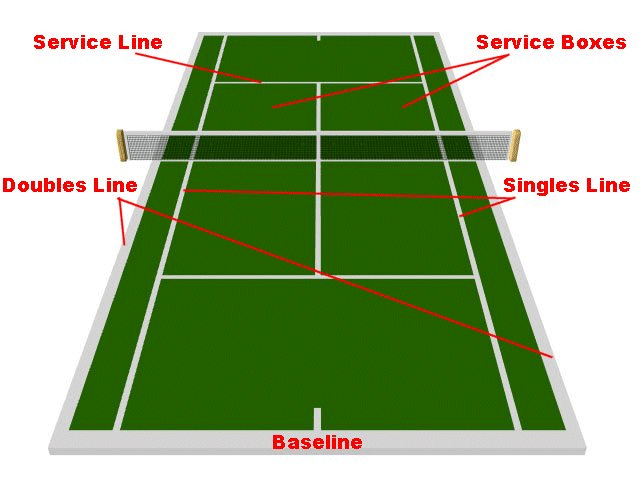
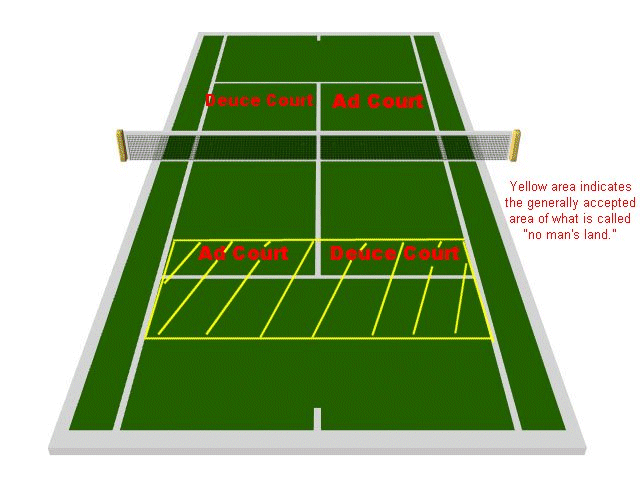
** Court Basics:
Throughout this FAQ, I will use terms like deuce court, ad-court, baseline, etc. These terms may or may not be familiar to everyone. Below are simple illustrations depicting these areas of the court.
Court Basics: Details various parts of a tennis court: baseline,
singles and doubles lines, service boxes, and doubles alley.
Court Basics 2: Illustrates the ad and deuce courts as
well as "no man's land." The term "deuce court" refers to the left service box
(and right baseline area when serving). The term "ad court" refers to the right
service box (and left baseline area when serving).
A
- Creating a Custom Player
Facial
Features: Virtua
Tennis 3 offers one of the weakest create-a-player modes ever found in a videogame.
Modification of pre-defined facial features is quite limited to where even at
extremes, very little change takes place to a custom character's overall appearance
(and if you opted to go to the extreme side of customizing your character, he/she
would look goofy).
Of course, your standard color options for eyes and hair are present,
a few choices for facial hair, as well as height and weight, but there
aren't really any variables that will truly distinguish your custom
character from most any other. I have found it virtually impossible to
make a likeness of myself (as I was able to do in TS2) or any retired professional
player that I wanted to resurrect in a virtual format.
Height and Weight: If you are living in a region where the system of standard weights and measures is used, you can use the following Web utilities to convert metric values to standard values for your player's weight and height:
KG to
LB (weight) Converter
CM
to Feet (height) Converter
When considering your player's height and weight, I would recommend the following ranges which are common among male tennis professionals:
Height: 5'10 - 6'4 (177.8cm - 193.04cm)
Weight: 170lbs - 185lbs (77.111kg - 83.915kg)
Swing Style: With regard to the serving and groundstroke techniques, that is pretty much a matter of personal preference. The forehands are arranged where the first option represents a somewhat continental grip with a low-to-high swing motion, the second which I believe was intended to be a semi-western grip (though, it is more on the side of a true western grip) that doesn't represent a real looping swing, the third a more traditional western grip, and finally an extreme western grip. For what it's worth, most clay-court players use a western grip to put an insane amount of topspin on the ball. That fact doesn't translate well with the game, as most players hit about the same with only the follow-through animations differing just a bit. The grip styles don't really influence much in terms of ball spin. If you are unfamiliar with the aforementioned grips, here are examples:
|
Grip Type |
Used By |
Physical example |
|
Continental |
Jimmy Connors |
Held as if you were shaking hands with the racquet. The ball is hit more "flat" than other styles. |
|
Semi-Western |
Andre Agassi |
Held as if you were picking a racquet up off the ground. The racquet is turned a quarter turn forwards from a continental grip. |
|
Western |
Sergei Bruguera |
Hand is behind the racquet. A lot more force is required to generate pace, but the amount of top spin is more extreme than other grip styles. |
Service Motion:
The service motions really don't impact the outcome of points, and are there
to more
or less provide "cosmetic value." They are arranged as follows:
1)
Classic service motion with slight toe drag.
2) Deep knee bend, feet set.
3)
Front foot moves, service motion similar to Andy Roddick's.
4) Rock to back
foot, similar to Pete Sampras' motion.
Service Return Motion:
Again, these options are merely another way of making your custom character unique. Any one of the following do not have advantages or disadvantages over the others.
1) One handed, split step. (Very uncommon).
2) Feet close, ready
position, commonly seen in doubles or by serve and volleyers (such as Stefan
Edberg who sometimes shared a similar ready position).
3) Hunched and sway
with split step. Fairly common by many players.
4) Upright sway with
split step. Another fairly common ready position.
Unlike Top Spin 1 where you could train as long as you had the necessary funds to pay for it, and Top Spin 2 where you had scheduled training sessions with various coaches, Virtua Tennis 3 offers limitless training opportunities that you can take advantage of before, after, or in place of tournaments. You can train for as long as you want before setting foot on a tennis court, or, you can delay your training until you feel the need to increase your skill levels to be more competitive. Of course, a rigorous training regimen will make winning matches easier, but it will also delay your rise to the top of the World Tour. If achieving the #1 ranking is your goal, then it would be best to devise a plan to work through each season in the most efficient manner possible; striking a balance between training, competing, and resting.
The World Tour consists of 20 seasons, not all of which are needed to max out your player or to achieve the world's #1 ranking. You should accomplish both of those feats well before your 20th season. After your 20th season, your player effectively retires. The only real incentives for actually playing through 20 seasons are the accessories you can acquire after tournament wins, Academy drills, and special accomplishments (such as winning all four Grand Slams in the same season, winning 50 smash points in a season, winning challenges made by other players, etc.).
Tournaments are scheduled year-round, each with restrictions on who may participate. Some tournaments (300 level Challenger events) are wide open in terms of participation and provide small rank improvements with each win. Other events such as the Advantage Series (204 level), "Masters Events" (100 level), and "Grand Slams" (56 level) feature pros with improved A.I., longer matches, and allow for better chances at improving your standing in the leaderboard. The more prestigious events will even host doubles tournaments which strangely enough, improve your singles ranking with each successful round. With certain tournament wins, you will obtain new accessories such as shirts, shoes, shorts, wristbands, glasses, and tennis racquets.
The opportunity to become #1 will be made available at the "King of Players" tournament in which you must be in the top 16 to enter. A different pro-player participates in each KoP event (depending on the year), and should you win, you will receive not only the #1 ranking, but a material item (such as a new racquet) for your accomplishment as well. KoP events are comprised of a six game match against ridiculous opponent A.I., and your custom player's stamina will begin to diminish after the fourth or fifth game of the match - so it's essential that your goal be a blowout win. Depending on your opponent, that's sometimes easier said than done. I found Lleyton Hewitt to be the most difficult, and Taylor Dent to be the easiest.
One of the unique elements of VT3 that separates it from other tennis games, is that your ranking will never slip if you don't participate in tournaments. For example, if you improve to #100 in the World Tour and then take an entire year off to train and rest, you can re-join the circuit with your 100 ranking still intact. There is absolutely no penalty for not participating in tournaments (other than it stunting your advancement through the rankings, and losing time from your 20 season career).
After you have successfully entered and completed each and every available tournament, including at least one KoP event, you will be invited to the SPT Final. The SPT Final is a special doubles match that will pit both King and Duke against you and the doubles partner you have had the most experience with over the course of your career. While this may seem like a formidable matchup, a win is definitely in the realm of possibility with the knowledge of a few key items (see Section E). Should you win the SPT Final, you will have unlocked the "Complete All Areas" Achievement worth 30 points. You will also earn a new racquet (a guitar), access to the royal court in Prague for use in other modes, and another viewing of the game development credits. A summary of your career up to that point will be available, including the interesting statistic as to how many accessories you've acquired. With the remaining years left on your character, you can finish up at the Academy or accept all practice matches that come your way. Either of those should unlock a few more items (if you are still missing certain accessories) which can be selected back at the house. You will also have the opportunity to face off against King (Level 1) in another SPT Final, this time in a singles format. Duke (Level 2) will appear for the SPT Final in the following season should you still have years remaining. At the conclusion of your 20th season, your player will effectively retire.
C
- Career Mode: Training
and Tournaments
The best way to approach World Tour mode is to find a balance between training, playing, and resting. Train during off weeks with an eye on the calendar for ideal times to rest before or after a big event.
Training Exercises: When participating in training exercises, be aware
that your movements will directly affect specific areas of your player's ability.
In other words, if you hit more forehands than backhands in a training
session, your forehands
will level up much more quickly. Additionally, in footwork training exercises,
lateral movements, cut-backs, forward rushing and backpeddling are all measured
independently. So, if you are only moving side to side, it might take
you considerably longer to level-up your ability to rush the net.
Skill Levels: Skill levels vary on the attribute being measured. For my first custom character, he was designated as having a "big serve." His skills were rated as follows:
|
General Category |
Individual Categories |
Maximum Level |
Max Out Each Area? |
|
Serve |
Power, Control |
33 |
Yes |
|
Forehand/Backhand |
Power, Control, Angle |
29 |
No (max 3 of 6) |
|
Volley |
Power, Control, Angle |
30 |
No (max 1 of 6) |
|
Footwork |
Turn, Rush Net, Lateral Running |
28 |
Yes |
Each subcategory under areas such as groundstrokes and volley (e.g. Power, Control, Angle) are subject to a limited number of key attributes being maxed out, and those will be the first ones that level-up to full capacity. This is indicated by a red bar and a briefly flashing "maxed." During your training exercises, be fully aware of how your skills are progressing, and which ones you want as your strengths. If you want to be an star player at the net, then you better focus on moving forwards and backwards during training drills such as Avalanche as opposed to running mostly laterally (Panic Balloon). When you reach levels 25 and higher, skill level improvement becomes increasingly difficult to equalize.
For example, if you want a powerful forehand to be your maxed groundstroke
(indicated by red bar), and it is currently at level 27 control with
the bar at 75%, and your power is at 10% (level 27), it will be VERY
difficult to increase your power so that it surpasses control.
More than likely, your control will become your maxed groundstroke attribute
since it will top out first.
|
Training Exercise |
Focus Area |
Difficulty |
Tips |
Comments |
|
Alien Attack |
Groundstrokes |
Easy: Levels 1-4 |
Immediately take out the left most and right most ball machines. You may need to shoot the left side down, then the right side, and then return to the left side and right side a second time before you start to work on the middle area. The reason for this is because even at level 29, once the corner "aliens" reach a certain point on the court, you will not be able to achieve enough angle to hit them! |
This is one of the easier training exercises to boost your groundstroke skill levels. |
|
Avalanche |
Footwork |
Easy: Levels 1-4 |
Depending on whether or not you want to be a baseline or net player, you should focus on your movements in this challenge. Move vertically as much as possible if you want to be a net pro. If running the baseline is your thing, work on your lateral movements as well as cut backs. |
For me, this was the easiest challenge to improve my custom player's
footwork. This was also the challenge that earned me an Achievement
for successfully completing a Level 6 training exercise. |
|
Balloon Sniper |
Serve |
Easy: Levels 1-4. |
Achieving max serves will increase your service
power tremendously should you successfully complete balloon sniper
training sessions. |
Yellow balloons are worth 100 points. |
|
Bullseye Volley |
Volleys |
Moderate/Difficult |
Try to find good placement to hit volleys as soon
as possible. Be prepared to move the analog stick forwards and backwards
to control depth of the volley until you find that "zone"
where you can return balls successfully (and consistently) for big
points. |
This is the most difficult of the volley training exercises. |
|
Court Curling |
Groundstrokes |
Easy: Levels 1-3 |
Similar to shuffle board, you must try to hit the stones to specific point ranges as indicated on the playing board. Should you meet your objective with shots to spare, and you are concerned of knocking the stones out of point range, simply lob balls over the stones to be safe. |
This is a fun challenge from levels 1-4. Levels 5 and 6 aren't worth it due to their difficulty, and considering that you have other options/training exercises at your disposal. |
|
Court Mania |
Technical |
Easy: Levels 1-3 |
|
This is a challenging training exercise that advances most aspects of your player (except for maybe volley). I would recommend not wasting your time on this after Level 3. There are other options where you can focus on what skills you wish to develop. |
|
Drum Topple |
Groundstrokes |
Easy: Levels 1-5 |
This is an easy challenge in the earlier levels, and one that will allow you to set up for either a powerful forehand and backhand. Be sure to balance out your groundstrokes. Too many shots from one side will have you leveling up unevenly. This challenge is worthless at Level 6 due to a barrel glitch. (see "comments" to right) |
This is a very easy training activity to boost your groundstrokes
when they are in early development. This exercise also doesn't
drain your custom player's stamina as much as other exercises. |
|
Feeding Time |
Volleys |
Easy: Levels 1-2 |
Focus on hitting your volleys with power, and take advantage of any high floaters that you can overhead smash. |
This is a good exercise since it puts a sense of urgency at your fingertips. I would recommend this exercise for early volley development. |
|
Panic Balloon |
Footwork |
Easy: Levels 1-4 |
When participating in this exercise, your best bet is to keep the analog stick pulled back on all of your shots. Doing this will keep the ball in front of the balloons where you can work your way towards the back of the group in a somewhat efficient manner. |
This is a good exercise to work on your lateral running skills. When it becomes too difficult for you, try attempting the Avalanche drill. |
|
Pin Crusher |
Serve |
Easy: Levels 1-4 |
This is a very good exercise to boost both your control and your max power. Be aware though that max power does not always get the job done. In some levels, the pin setup will require you to do a half-speed serve so that the ball bounces into the pins for maximum effect. |
There is an Achievement for serving up three strikes in a row
in Level 4 or higher,
and that alone makes this training exercise worth it. Should you
get a "turkey," you will be awarded a frying pan as a
racquet in addition to your points.. |
|
Prize Defender |
Volleys |
Easy: Levels 1-4 |
This is the easiest of the volley challenges. For the higher difficulty levels, keep your eye on the blinking machines, and don't react until you see the ball released. In levels 5 and 6, a machine will intentionally shoot a ball wide in order to coax a dive from you. If that happens, you most likely will not recover in time to protect the prizes. The machines do have patterns, so if you become familiar with them, power up your volleys so that you hit the ball with authority. Add angle to your shots too. By doing that, your power and angle skills will increase dramatically! |
This is the training exercise I used to top off my volley skills. Level 6 is difficult, but definitely attainable. Level 5 is of moderate difficulty, but can be defeated if you keep your eyes on the barrel of the machine, resist anticipation, and keep your feet on the ground. |
|
Super Bingo |
Technical |
Easy: Levels 1-3 |
This is a challenge I lost interest in after Levels 3 and 4. My opinion: I feel there are better (and more fun) challenges to improve your player with. |
This is one of the more frustrating challenges simply because so much time is wasted when the ball machines are idle. The delay in firing after your last groundstroke is about 3 to 4 seconds, and those are precious seconds needed, especially in the higher levels of this challenge. |
Resting: "Resting" is an option that is new to tennis videogames, and one that is of tremendous importance in VT3 if you want to proceed through the game with the utmost efficiency. Inadequate rest will likely result in a bodily injury to your custom character that could put him (or her) out of commission from weeks to several months. I've heard of shoulder injuries, knee injuries, elbow injuries, stress fractures, and even a broken femur (that was my guy!) all taking place due to insufficient rest.
Training can put a strain on your custom player, especially if you are training for more than three consecutive times in a given month. Be mindful that pushing your player will undoubtedly result in a setback due to injury. To test your physical conditioning, be alert to whether or not your player is still able to hit running forehands. If you notice that he is diving for shots that he'd normally hit on the run, then he is tiring out, and you should rest as soon as possible.
If my custom player is pretty well-to-do stamina-wise prior to an event, I won't rest. However, at the conclusion of a tournament, I make sure to take a rest. That way, I am assured that my custom player is no longer prone to an accidental injury. If my player has taken a beating from practice with little time to recover before a tournament, I will take a rest at home just prior to the event, followed up by a vacation afterwards. The energy drink does not prevent injuries; it is merely a stamina booster to top off your energy level prior to an activity.
- Pro Insight: The energy drink is particularly useful when a doubles event follows a singles tournament in back-to-back weeks.
True rest (i.e. a vacation) helps your
player fully recover, and returns his (or her) stamina its maximum level.
Below are a few things that really beat your player's stamina down:
- three or more consecutive weeks of training (especially events that target
the same part of your body)
- very long matches (such
as KoP events)
- excessive diving
Just because your stamina meter
shows "full"doesn't mean that your player won't be injured. Too
much court time and too little rest may spell disaster. Energy drinks
don't protect you, and home rest can only do so much if you are constantly playing
long, endurance-type matches. A vacation is the only option to ensure
a complete recovery. Vacations
aren't as essential later in your career when you are handling the competition
with ease; home rest is sufficient there - - but early on, you may want to consider
a vacation every now and then after winning a tournament.
Academy Training: Training
at the Academy provides you an experience that falls somewhere between the standard
training challenges and practice sessions with other players. Equipment
rewards are issued after certain accomplishments and your skill levels improve
after successfully completing each task at the Academy.
Please note that
training at the Academy is not required to achieve the #1 ranking. The
purpose of the Academy is to assign you specific goals to attain within a certain
amount of time. The scenarios you are presented with are supposed
to mimic in-game situations you might
face. I use the words "supposed to" because at the Advanced
and Expert levels at the Academy, the assignments given are utterly ridiculous,
not to mention tremendously difficult to accomplish.
Player Practices: Player practice requests are a good way to test your skills against a pro who is set at a level slightly weaker than yourself. While participating in a pro-player practice session offers the opportunity to improve your overall skill sets (i.e. forehand, backhand, footwork, serve, volley), the true benefit comes from the fact that after multiple practice sessions, you will begin receiving challenges by pros to compete in specific challenges, such as the Pin Crusher. Winning a pro-player challenge will earn you new equipment such as a better racquet.
Tournaments: Tournaments are arranged by ranking level. To start, you will be allowed to enter all 300+ level (Challenger) tournaments. The Challenger tournaments are comprised of three rounds, and a single two game set. If you are good, you should be able to win a 300+ level tournament in under five minutes. Winning entry-level tournaments will get you 28 points very early on, however, the point value decreases as your ranking improves (only 8 points to win Challenger VI). Doubles tournaments are also available for select Challenger events, and wins there will count towards your player's overall ranking.
200+ level tournaments (Advantage Series) are tournaments you will likely enter during your second season. These events feature both singles and doubles, and provide a slightly increased level of difficulty. As was the case with Challenger tournaments, point values are reasonably high for the first few Advantage Series tournaments, but slowly decrease as your ranking improves.
100+ level tournaments. The level of difficulty kicks up a notch at this stage of the game. Here, you will really need to focus on training essential elements of your game so that you can be successful in these tournaments. As outlined in the next section (Section D), this is a critical part of your career where rest, training, and match play must be planned out. Wins at the 100 level tournaments will help you qualify for the next level of competition: The Grand Slams.
56 level tournaments (Grand Slams): It goes without saying that these are the big events that should you win, will propel you to the number 2 position. Depending on what season you begin playing the Grand Slams (assuming you win them), you may need to win either two or all four. If you follow my guide to becoming #1 as quickly as possible, you will be required to win all four titles to earn the #2 ranking.
Here, the tournament format is two rounds, each round consisting of a single four game set. The difficulty will become much more intense as your player will likely be overpowered by many others. James Blake, David Nalbandian, and Lleyton Hewitt are the most difficult guys to beat due to their overwhelming groundstrokes.
King of Players:
This is the tournament you must win to effectively become #1. You could
win grand slam after grand slam for the entire course of your custom player's
career, and still never get to be #1 unless you win this event. To qualify,
you must rank in the top 16.
This will be the most difficult match you
will face against a pro player due to stamina drain on behalf of your custom
player, and to the increased level of difficulty from your opponent. Each
season, a new pro-player will appear in the KoP tournament. So, if you
don't have success against Taylor Dent in Season 4, you may perform better against
another player in Season 5 or 6.
KoP Tournaments consist of a single set where the first to six games is declared the winner. For this event, I would recommend being completely rested up (i.e. take a vacation so that it concludes on the day of the KoP), consume an energy drink on the day of the KoP event, and check to make sure you use the best tennis racquet in your arsenal. You will be rewarded with earning the wooden racquet used by both King and Duke. I'd recommend using this racquet for the remainder of your career.
SPT Doubles Final:
After winning the KoP event, you will qualify for the SPT Doubles Final
which pits you and the pro-partner you teamed with most over the course of the
season versus both King and Duke (level 0). This is a difficult match
to win, however, I provided tips in Section
K that should help you
considerably. Winning this match will prompt ending credits to roll, and
a display of your career statistics.
SPT
Singles Final 1: If you continue
to play your career, the SPT Final will become a singles event in which you
play King (level 1) by himself. Again, this is a very difficult match,
and one where your custom player should have all his skill attributes maxed
out before entering. I have tips
posted on winning this event as well. Winning this match will again roll
the game's credits and provide you a summary of your career thus far.
SPT
Singles Final 2: If you pursue your
career further by another year, a new SPT Final will be made available; this
time versus Duke (level 1). In my opinion, Duke is substantially harder
to beat than anyone in the game, largely in part because of his cheesiness and
diving lobs. I have posted some notes on how to beat Duke HERE.
At the conclusion of this match, the ending credits will roll and a summary
of your career to this point will be displayed.
If you continue to play additional seasons, the SPT Finals will recycle themselves until your 20th year where the game effectively ends.
- Fun Fact: Did you know that one of the most uncommon animations in VT3 is a between the legs shot? You will most likely see it in the SPT Final as King and Duke do it regularly when unintentional shots go over their heads, but it is very difficult to pull off on your own. I've done it twice, once offline in World Mode, and once in an online game where it shocked my opponent. In order to successfully pull off this tricky maneuver, you must time the landing of your opponent's lob perfectly. As soon as a lob goes up, you must already be retreating, and you must have the ball land right behind you (literally) so that your guy's animation already has him turned around (facing you). Should you do this just right, your player will slap the ball between his legs and back over the net. Because it happens so fast, I don't think it's possible to actually place the ball, or to power up so that it gets hit with more force. It's pretty cool when you do it, but lame when it happens so frequently by King/Duke in the SPT Final.
D - Getting to #1; Seasonal Breakdown
I would think that most
everyone's initial goal with Virtua Tennis 3 is to complete the World Tour mode with their
first player, and for any subsequent custom characters, to get them online-ready as
soon as possible. With that in mind, below is my recommended course of
action to get your custom player to #1 in World Tour mode as quickly as possible. Please
note that dates such as "Jan 1" and "Jan 2" represent the
first and second weeks of January respectively. I feel that the plan I've
outlined below is the most efficient (and quick) way to achieving the #1 ranking.
|
Date |
Action |
Comments |
|
Jan 1 |
Train |
I'd recommend starting off with the pin crusher. Level 1 is easy to accomplish. Try getting at least two max serves here. |
|
Jan 2 |
Train |
Move over to the Drum Topple and try to focus on just your forehand or your backhand with max power. |
|
Jan 3 |
Train |
Move over to the Alien Attack exercise. Hit the corners first and focus on the red machines with max power. |
|
Jan 4 |
Train |
Go back to the Drum Topple, and work the other side (the side you didn't work on for Jan 2). Take an energy drink. |
|
Feb 1 |
Train |
Return to the Drum Topple (it doesn't take a lot of stamina to play),and try Level 2 of this exercise. Try to even out your forehand and backhand if there is a big difference between the two (i.e., if your backhand is one level behind your forehand, try to hit one or two more backhands in this exercise. Take an energy drink at the conclusion of this exercise. |
|
Feb 2 |
Tournament |
Challenger 1 Tournament. Enter this event and focus
on winning matches as quickly as possible, with as little movement
as possible. Try to stay at the center of the baseline and
dictate the points by powering the ball to the corners. On
service returns, take a step or two back from the default position
and return balls with power down the lines. Your ranking will
improve as follows: Your new ranking will be 272. You will earn a new pair of shoes for winning the event, and a new wristband from your coach. |
|
Feb 3 |
Rest |
Take a well deserved rest at Home. Super Bingo should become available as a training exercise. |
|
Feb 4 |
Train |
Court Curling becomes available at this point, but I'd recommend going back to the Drum Topple and trying to get both your forehand and backhands leveled up, and fairly even with each other. The Drum Topple does not impact your stamina as much as some other challenges. |
|
March 1 |
Train |
Balloon Sniper becomes available, but for now, let's stick with Pin Crusher. Again, try to focus on hitting max serves in this exercise because it will really improve your power rating. Press up on the stick to have the serve land deep in the service boxes when appropriate. |
|
March 2 |
Train |
Drum Topple: Work on just forehands with max power. |
|
March 3 |
Train |
Drum Topple: Work on just your backhand with max power. After finishing, take an energy drink. |
|
March 4 |
Tournament |
Challenger II event in Buenos Aires (clay). Again,
take a step or two back when returning serves and put them all down
the line. Try not to run around chasing shots, and dictate
each point by pounding the ball to the corners. The less movement
you make the less your stamina will decrease. Try your best
to win each match without losing too many points. |
|
April 1 |
Rest |
Rest at Home. At this time, you should check your gear and determine if you have better options (i.e. a more powerful racquet to use). |
|
April 2 |
Rest |
Rest at Home. You will have back-to-back tournaments coming up, and inadequate rest can lead to injury if you practice on this day, and then compete in two tournaments. Right now, your groundstrokes should be between Levels 6-7, and your serve around 3-4. |
|
April 3 |
Tournament |
Challenger III singles event at Moscow. This tournament should be a walkover for you. Again, try to focus on winning without dropping a game. Round 1: 4 points After successfully completing this event, you will win new sportswear. |
|
April 4 |
Tournament |
Challenger III doubles event at Moscow. Choose a
doubles partner and hit the courts for a two round doubles tournament
that will affect your singles ranking. Keep in mind that the
player you choose most often from here on out will be the player
you are paired with when you face the King/Duke combo for the SPT
Doubles Final. |
|
May 1 |
Rest/Vacation |
You may get a message that your player is very tired. Take a Vacation and get him back to full health. |
|
May 4 |
Tournament |
Challengers IV singles event in Phuket (that's pronounced "foo-ket"). Again, with your skill levels, this tournament should be a breeze. Round 1: 3 points |
|
June 1 |
Rest |
Take a Vacation |
|
June 4 |
Training |
Choose Alien Attack (Level 2). Try to power up on every shot, and attempt to keep your forehand and backhand levels balanced. HALFWAY POINT OF SEASON ONE SUMMARY: |
|
July 1 |
Training |
Alien Attack (Level 2). You'll need to start really training hard now to get your player prepped for the tougher 204 ranked tournaments. Try to power up on every shot if you can. |
|
July 2 |
Training |
Balloon Sniper (Level 2). Go for max serves when the opportunity presents itself. |
|
July 3 |
Training |
Prize Defender. You will likely need to approach the net to end points early next season. No better time than now to start working on this skill. |
|
July 4 |
Training |
Prize Defender. Your volley skills are weak, and need to keep working on them. |
|
August 1 |
Rest |
Rest at Home. The four weeks of training has worn your player out. |
|
August 2 |
Training |
Avalanche. Your player's speed will become a factor during the second half of next season. |
|
August 3 |
Training |
Alien Attack. Your ground strokes will need to be
around Level 15-17 to have a shot in the Grand Slams. Start
preparing now! |
|
August 4 |
Rest |
Take a Vacation. You have another double-header coming up. |
|
September 3 |
Tournament |
Challenger V at Casablanca (clay), Singles. Round 1: 6 points You will receive a new racquet for winning this event. Pro Strategy: If you find that certain player's groundstrokes (e.g. James Blake) are preventing you from making an offensive shot, then begin relying on your slice. |
|
September 4 |
Tournament |
Challenger V at Casablanca (clay), Doubles. Round 1: 3 points |
|
October 1 |
Rest? |
On this date, you can either rest, and then work on a quick drill such as the drum topple, or do the drum topple, and then rest. I chose to rest first on this date because my stamina might not have recovered very much after having two tournaments and a training session in three consecutive weeks. |
|
October 2 |
Train? |
Go for a quick and easy groundstroke training session here: the Drum Topple. It will level up your groundstrokes with minimum effort. |
|
October 3 |
Train |
Balloon Sniper. You will need to start beefing up that serve of yours. Level 204 singles matches can be tough to win with a weak serve. |
|
October 4 |
Tournament |
Advantage Series Mixed Doubles in Tokyo. Pick whatever
female partner you wish. I chose Sharapova. |
|
November 1 |
Quick Rest/Tournament |
Challenger VI Tournament in Cape Town. Grab
an energy drink to max out your stamina meter and head on over to
this event. This should be a very easy win since your recent
training has boosted your abilities far beyond the competition of
this tournament. |
|
November 2 |
Training |
Balloon Sniper. This is an excellent exercise for increasing the control of your serve - with multiple chances to get max services to boost your power rating too. |
|
November 3 |
Training |
Return to the Balloon Sniper. |
|
November 4 |
Training |
Balloon Sniper. Right now, you'll need to begin making important decisions. By taking on the balloon sniper instead of the Challenger VII event, you are preparing to enter the level 204 tournaments. If you choose the Challenger tournament, you'll be setting yourself back a week in development. It's a trade off here, but getting prepped for bigger tournaments with bigger payouts (in terms of ranking points) is the higher priority right now. |
|
December 1 |
Training |
Prize Defender. Your volleys will need to be at least somewhat effective (level 10-11 by the end of Season 2). |
|
December 2 |
Rest |
Rest at Home so you can squeeze one more training session in before the end of the year. You will likely earn Rookie of the Year honors and awarded a new outfit. |
|
December 3 |
Rest |
Rest at home (and enjoy the holidays). You'll kick off the new year with lots of training to get ready for level 204 tournaments. |
|
END OF SEASON 1 |
Total Time: |
Year End Ranking: 157 |
E
- Offline Strategies
(Defeating Pro Players)
Below you will find proven strategies that I've developed
to defeat specific pro players in the offline World Tour mode. The details
listed below are most effective when your ranking is between 50-200. If
your ranking falls somewhere around 50-100, you should have no skill set below a level
10. In order to be truly effective, your groundstrokes should be between
levels 14-17 and all aspects of your serve at level 14 or above. You can
get by with footwork and volleys being around 10 or 11 at this stage, but I
would recommend boosting them up a bit if they are in fact that low. All
advice listed below assumes that your custom player is right handed. If
this is incorrect, make a mental note that when I say "backhand,"
it will refer to your lefty's forehand.
These
strategies have proven quite effective for top 50 offline competition as well - though,
your groundstroke and serving skills should be at or around level 20 by that time.
Click Name
to Advance to Appropriate Section:
Mario is not a very formidable opponent, and you should defeat him handily throughout world mode, but if you are struggling, here are a few tips to help you win some easy points:
- Pro Tactic: When receiving Ancic's serve on the deuce side (and assuming you have a solid backhand ), take two steps behind the baseline and one step to the left. Power up your backhand to receive his serve to that side. Put your return of serve down the line. This will almost always cause Ancic to dive after the ball, leaving you the option of taking the ball in the air with a smash, or allowing it to land so that you can drill to the open court. Ancic is very predictable with his serves to the deuce court, and you should be fairly confident in where they will be placed each time.
Beating James
Blake:
James Blake is one of a few players where
right around the ranking of 100, can be challenging to beat due to his crushing
groundstrokes. Most often, they are overpowering at that stage in your
custom character's career.
Given the fact that every player in this game has a pattern when facing certain scenarios, I've discovered two that have given me the edge in beating Blake while my ranking was between 80 and 100.
Pro Strategy: When James is serving (ranking around 100). Take two steps back and drop shot his serve. As soon as you do, rush the net and prepare to get James' first scoop. Hit the ball to one side (preferably, the side you are closest to), and fake as if you are going to move to that side as well. James will most likely reply with an attempt at a cross-court volley (the opposite direction). Be prepared for his shot, and block the ball to the open court for a winner.
When you are serving (ranking around 100): Line up as close to the center hash mark at the baseline, and use "B" and "X" to spin your serves out to the far corners of the service boxes. Similar to how King reacts, James will hit his service return down the line. Because his groundstrokes are much more powerful than yours, run to the sideline and power up your SLICE for a strong cross-court shot. As soon as you strike the ball, charge the net and get ready to volley (or overhead smash) his next shot. This tactic works almost 100% of the time at this stage in World Mode.
Pro Strategy: If your ranking is around 88 or better, James will adjust his game plan slightly when you are serving. Instead of him hitting your spin serves down the line, he'll hit them around mid-point between the sideline and center point of the baseline (e.g. about 6 feet over from a down-the-line shot). You will only need to adjust your player a bit to hit your powered-up slice cross-court. Because he's not hitting down the line, he's reducing your angled return. So, depending how you are positioned, your angle can be maximized. Be sure to charge the net as soon as you hit his service return, and if done correctly, you can still win almost 100% of the points you begin.
Beating Taylor
Dent:
Beating Taylor Dent is a relatively easy thing to do, since he
follows a very predictable set of behaviors when presented with specific scenarios.
When returning serve, take a step or two back from the baseline. This
will help you return his serves with a bit more pace. Additionally, I'd
recommend slicing back his serves as opposed to using top spin, and do so where
they are placed down the line.
A few key strategies when
playing Taylor Dent:
- Pro Tactic:
When Taylor is serving to the
ad-court, always slice your return down the line. His momentum will be
carrying him forward after his service motion. As a result, he will either
take a stab at your ball, or he'll stumble trying to get it back. Either
way, he'll float a ball back to you. Get yourself in position to hit it
off your strong side and deep into the deuce court. This should provide
you a VERY EASY way of earning points off of Dent on this side of the court.
- If by chance Taylor gets to the net, never try to pass him with a cross court shot. That is his bread and butter volley - he'll put that away for a guaranteed winner. Always try to pass up the line (shortest distance between points A and B). Also, never lob. You'd just be giving him the point by doing that..
- Pro Strategy: Taylor sometimes looks for you to hit behind him, so don't try to play that game against him. If he hits it to the left, you keep that ball to the left. If he hits it to the right, then hit it back to the right no matter where he is on the court.
- Pro Tactic: Never lob cross-court against Taylor Dent. NEVER. If you see Taylor Dent take a half volley or full volley inside the service line, he will likely rush the net and commit to that part of the court. If you are in good position and the ball is coming towards you with decent speed, lob down the line (if you are near the line). For some reason, that is the ONLY lob that Dent can't chase down. Make sure you press 'up' for added depth.
Despite currently being the best tennis player on the tour (in real life - 2007), Roger is somewhat of a weakling in Virtua Tennis 3. He is considered an "all around player" which means that he has no specific weaknesses, however, the drawback is that he has no real strengths either. Unlike Top Spin 1 and 2, "precision" (which Roger is credited to have in VT3), isn't as much of a factor in Virtua Tennis 3. From my experience with two runs through World Tour Mode, Roger Federer was one of the easiest guys to defeat at any difficulty level. Here are a few things to look out for when playing him:
- Pro Strategy: When returning Roger's serve from the ad-court side, slice the ball back cross-court with as much power and depth as possible. Look for Roger to slice it back cross-court. This sometimes indicates that Roger's A.I. is (or has) fallen into a specific gaming pattern. Slice the ball back cross-court two more times and on the third opportunity, power up and drill it down the line. Roger will either get wrong-footed and miss your shot, or, he may get to it, but will be forced to float the ball back over the net as a weak reply.
Now sometimes Roger will not follow this pattern. If he does not allow the cross court exchange on the first time you try this, limit your cross-court shot to only your return of serve (or perhaps one more time before hitting down the line). If Roger does allow you to get away with the three slices cross-court (including the service return), then he'll likely fall for that strategy several other times throughout the match.
Also to note, Roger likes hitting overhead smashes
cross court when he's located in the ad-court (right side) back at the baseline.
If he is at the baseline in the deuce court, he prefers to hit overheads
down the line.
Another tactic you can try is to hit "behind him."
That is, get him running in one direction out of anticipation, and
hit behind him to where he previously was. Roger seems to be more prone
to this tactic than other players in the game.
During Grand Slam competition, Ferrero's only real strength is his forehand. Do your best to keep the ball to his backhand side during rallies until you are able to put the ball away to his forehand side. A few of these strategies have proven to work well against Ferrero at the more difficult stages of World Mode:
- Pro Strategy: When serving against Ferrero, hit your serves down the line and as close to max power as possible. Doing so will almost always have Ferrero hitting a neutral return close to the middle of the court, but slightly on the Ad-Side. If you anticipate this return early enough, you can hit a powerful backhand (assuming you are right handed) to the open court for a winner - - or at the very least, have Ferrero dive to get the ball. If you have decent foot speed, you should follow in behind your backhand in case JC does in fact get the ball. If he pops it up or floats a weak reply, you should be able to easily put it away with an overhead or volley to the open court.
- Pro Strategy: When returning JC's serves...
On the Deuce Side: slice the
ball cross court. Or, if you anticipate his serves well, take an extra
step behind the baseline and power-up your service return and hit it as far
left as possible (pulling back on the analog stick for extra angle is even better).
His reply should be weak enough for you to put away on your next shot
(or - REALLY put you on the offensive).
On the Ad-Side: Slice the ball
down the line. For some reason, Fererro sometimes hesitates (and even
stumbles) when a service return is made from the Ad-Side and hit down the line.
Again, if you are good at anticipating his serves, take a step back behind
the baseline, power-up your forehand or backhand, and drive the ball down the
line.
Much like Tim Henman in Virtua Tennis 3, Sebastian Grosjean is a punk with ridiculous frequency of drop shots. Always be prepared for him to hit a drop shot at least one time per point if a rally exceeds three shots over the net.
- Pro Strategy: When Sebastian hits a drop shot, power up your ground stroke as you are running forward, and be sure to hit the ball with top spin down the nearest sideline. Once you do so, begin to cheat a little towards the center of the service box nearest the sideline you just hit your shot to. If Sebastian hits a regular groundstroke, you should be able to easily cut off his shot with a volley to the open court. If he dives and pops up a lob, you shouldn't have to move to far to get underneath it for an overhead smash.
Beating Tommy Haas:
Tommy
Haas can be another walkover in Virtua Tennis 3 with the proper game plan
in place. Tommy has an all-court game and may have a specific set of artificial
intelligence behaviors, but I've never given him enough time to display them.
My points against Tommy are usually over in five strokes or less.
Try this:
-
Pro Strategy: When serving against Tommy, always serve as far
out wide as you can. A max serve will only help your cause here. Tommy
will return the ball just beyond the service tee on your side, and in the center
of the court. Line up your strong side to punish this ball as soon as
it lands, and you should have an easy 1-2-3 winner every time.
Example: Your strong side is your forehand. You serve out wide from the deuce court. As soon as you serve, you should be anticipating the ball being returned around mid-court. Begin stepping around to expose your forehand (and powering it up). Hit the ball to the ad-court on your opponent's side for a clean winner.
Pro Strategy: The strategy I posted for Taylor Dent will work for Tim Henman as well, however, you will need to be on your toes anticipating his cheesy drop shots which are a staple in his game plan. If Henman drop shots the ball, always power up your shot as you approach the ball, and hit it down the nearest sideline. Your next action should be covering the net area around the service "T" (though, slightly towards the side the ball was hit). Tim will most likely respond with a non-powered-up cross-court shot that you should easily volley to the open court for a winner. Because the Tim Henman in VT3 drop shots so frequently, you can win quite a few points from this technique.
Always hit his shots to the nearest sideline. Cross-court
attempts will likely be volleyed away for a winner.
Season In my opinion, Lleyton Hewitt is the toughest non-boss character to beat in the game, ESPECIALLY in the King of Players event. Here are a few tips that should help you beat Lleyton:
-
Pro Strategy: When you
get involved in a rally, take two to three steps behind the baseline. You
will not only allow yourself more time to react to his shots, but you will be
able to get much more power on the ball. Doing this will overwhelm Hewitt
and put you at a considerable advantage! However, be advised that
if you mess up on a power shot (i.e. hit a weak ground stroke) and allow him
time to prepare, Lleyton will attempt to win a point off a drop shot. Keep
a look out for this.
-
Pro Strategy: When serving
on the deuce side, serve down the middle. Hewitt will almost always hit
his return down the line.
During Season 1, there is no better player to drop shot than Gael Monfils. He likes to stand so far behind the baseline that he's almost begging for you to hit a drop shot. Try to get him well behind the baseline and to one corner. Move your custom player inside the baseline (preferably just shy of no-man's-land) and drop shot the ball to the opposite corner (by pulling back on the analog stick and slightly towards the side you want the ball to go). In Season 1, this is almost a guaranteed winner, and will help contribute towards your goal of obtaining the Drop Shot Achievement for Xbox Live.
In later seasons, his power increases, thus making the frequency of drop shots more difficult to obtain. When you play Monfils in the top 50, you can still drop shot him, however I'd recommend running in behind the ball. He'll likely scoop the ball up in the air if he reaches it, which should allow you to either volley it to the open court, or smash it away for a winner.
Rafael Nadal begins to become a minor nuisance when you settle in around the top 100 ranking. His speed is by far the best in the game which may prolong some of your rallies. If you entered a tournament already fatigued, your performance will begin to deteriorate the longer the match persists. Patience is the key when playing Nadal, and your best success will sometimes come when you allow him to dictate the points (as strange as that sounds). From my experience, there are two strategies that seem to work consistently well against Nadal.
-
Pro Strategy: Return and Charge:
This
tactic works best if you have a level 10 or better rating for approaching the
net, and a volley level of at least 12. When Nadal serves, slice the ball
towards the far corner of the court (the same side he's serving from).
For instance, if he's serving from the deuce court, then slice his serve
back to the far outside corner of the deuce court. As soon as you
slice the ball (powering up the slice is a good idea), charge the net as quickly
as possible and position your self right around the center area of the net.
Depending on your approach vector, Nadal will either try to pass you cross-court,
or go down the line. Either way, you should have the advantage. If
he tries for a down-the-line pass, you should have that covered with a sharp
volley away from him. If he goes cross-court, you can very well cut
that ball off with good anticipation. If you hit it forcefully, you should
earn yourself a winning shot. Be alert to how he reacts to you
doing this. Again, his shot selection seems to be related to how you approach
the net, whether it be directly to the net in a straight line, or in more of
an arcing movement.
This tactic has proved quite successful
for me, but it isn't fool proof. Sometimes my player's volley isn't perfect,
or, my player will dive. Because of that, I try to mix things up a bit
so that I can go back to this tactic when I need a critical point. When
I mix things up, I resort to....
-
Pro Strategy: Cross-Court Rallies:
Raf likes to stretch his opponents out wide with sharp angled ground strokes. Should you play into his set-up, you will
both be outside the singles area trading forehands and backhands.
My recommendation is this: unless you are in perfect position to trade normal forehands or backhands with a decent amount of pace, I would suggest slicing the ball back to him at a comparable angle to keep him pinned to that far corner. Pulling back on the stick and towards the direction you are hitting the ball (i.e down and left or down and right) will ensure that Nadal stays put. The reason slice is the better option here is because if you mis-time your top spin shot, it will be an off-speed ball, guaranteeing that Nadal will crush it down the line for a clean winner. Timing is too critical with the top spin shot in this scenario. Using slice will keep Rafael at bay even if your timing is just a bit off.
Typically, Rafael will hit three wide angled shots to set up for the one down the line. In some cases, it’s two shots out wide before the down the line attempt, but most of the time, it’s three (or four). The trick is to keep slicing the ball back to him at a comparable angle. Try to position yourself to retrieve his shots out wide, but without committing to staying outside the singles lines, which will signal him to go down the line. On his third shot out wide, power up your shot and slice it down the line. If you slice it short, it may cause him to dive after it. Be ready to move in if this happens. The ball will be an easy put-away if it’s a lob or a regular put-away volley to the open court if it’s just a weak shot return. I wouldn’t recommend hitting a top spin shot down the line in this case if you have ground strokes under level 15.
When I start off a point as the receiver against Nadal, I usually try to return his serve down the line to put him in a corner position – and let the rally develop from there. The scenario described above usually unfolds, and with the aforementioned strategy, points are easier to obtain.
- Pro Strategy: End Nadal's cross-court rally nonsense early
As you have undoubtedly observed, Nadal likes to hit cross-court shots with extreme angles. If you find yourself involved in a cross-court battle, slice a cross-court shot as wide as you can, and as short as you can. As soon as you do, rush the center of the net. If your footwork and volley skills are sufficient, you should get there in plenty of time to cut off his next shot with an easy put away volley into the open court.
- Pro Strategy: Drop-Service Return
The "cheapest" way of beating Nadal is to drop shot his serve down the line as best you can, and quickly rush the net to volley his attempt at a cross-court winner. Rafa will almost *always* go cross-court when chasing one of your drop shots.
David Nalbandian is one of the tougher players
to beat, primarily due to his forceful backhand. More often than not, it is
overpowering and can lead to many floating shots by your player (and unforced
errors!)
-
Pro Strategy: Slice
the ball
Always
use slice shots against David's backhand, preferably powered up and cross-court.
This will make your shot not only an effective return, but will also reduce
any margin for error (if you hadn't powered up sufficiently).
- Pro Strategy: Cross-court rallies, know where you should be
If you face David in a Grand Slam with your ranking between 20 and 56, he will almost always hit his groundstrokes cross-court. So, if you hit to the left side of the court, position yourself on to the right sideline because that's where he'll hit his next shot. Conversely, if you hit the ball to the right side, run to the left to cover the area his next shot is heading. What I liked to do in these situations was power up my slice shots as soon as he was about to hit the ball. I'd also pull back on the analog stick and towards the direction I wanted the ball in order to produce a wider angle. This caused him to lose a little power on his returns. Additionally, after about the third or fourth time the ball traveled over the net, I'd drop shot the ball to the middle of the court, and IMMEDIATELY run in behind it. David would often be caught flat-footed, and either not get to the ball in time, or, he'd stretch and pop it up. The latter is an easy put away with a volley or overhead smash.
If you play Nalbandian in a Grand Slam with
your ranking under 20, his cross-court shots aren't as predictable, where some
times he chooses to hit the ball down the line after one or two cross court
shots. Keep him on his toes by allowing a few cross-court shots to take
place, then slicing the ball down the line to make him run. As soon
as you hit your shot down the line, quickly get into position on the other side
of the court, and repeating the cross-court rally again. When you get
into a cross-court rally, try once again to drop shot the ball, and quickly
run in behind it. If your net-approach foot speed is sufficient (approximately
a level 14), you should have no problem getting there in time. David will
either miss the ball, or pop it up that you can easily put away.
-
Pro Strategy: Place
your serve
When serving, try to aim your serves with
max power right down the center line. David's returns have little angle,
and you should be able to observe where they will land, almost in predictable
fashion. When you serve from the deuce court and down the line, David's
returns will be to your backhand side. Place your max serve down the line,
move a bit to your left and power up your backhand. To make it more effective,
pull down and to the right on your analog stick. You should drill your
groundstroke at a tight angle that he'll either miss completely, or pop up with
a diving attempt. Rush the net for an easy put-away if necessary.
Beating Andy Roddick:
Just like in real life, two things make Andy an effective and feared player:
1) his serve, 2) he capitalizes on opportunity. In VT3, you need
to nullify those two things from deciding your game in his favor.
- Pro Strategy: When Andy serves, take three full steps back from the baseline. If your top spin shots are still going out of bounds, then fall back to the slice. Power up your slice and put it cross court, and begin the point from there. This is pretty effective when receiving the ball from the deuce court.
- Pro Tactic: In the ad-court, try powering up a slice deep down the line. As soon as you hit the ball, feint a move to the right as if you are going to cover the deuce court, but don't actually commit to it. Andy will likely hit your ball back down the line, which you can easily get back into position for, and blast a cross court shot for a winner. I relied on this tactic heavily during my two KoP matches against him (two different seasons).
Beating King (SPT
Singles Final):
Pro Strategy:
When
you serve against King from the deuce court, get as far left as you can to serve
(that little hash mark at the center of the baseline is as far as you can go).
Serve a 1/4 to 1/2 speed serve into the outside corner of the service
box. As soon as you serve, cover the LEFT sideline and power up for a
cross-court shot. King will ALWAYS hit his return down the line
there. You will be ready to rip, and it will either be a clean winner,
OR, he will dive and float the ball back up into the air for you to smash. Since
your custom player is much less powerful than a pro found in the game (see FAQ
section about beating King), I'd recommend pulling back on the analog stick
and towards the corners when you hit a powerful shot. This will make the
ball land short, which sometimes has King diving to get it before the second
bounce.
Pro Strategy:
When
you serve against King from the ad-court, get as far right as you can before
you serve (again, basically the center of the baseline). Hit a quarter
to half-speed serve out wide, and hustle to cover that right singles line. King
will hit his return down the land and you should be ready to blast the ball
cross-court. If your forehand is your strength, you should hit a clean
winner. I used James Blake and he made it VERY EASY for me.
Pro Strategy:
King has an offensive pattern which when in play, can
be used against him. The trick is to get him to play in this particular
pattern, and anticipate his shot placement. You'll find it frustrating
at times to get him to do what you want, but when he does, you need to be immediately
aware and take advantage of it.
King's pattern is this: If you
hit a cross-court shot to the right side of the court, King will run to that
side and hit the ball down the right sideline. If you are there in time
and hit the ball cross-court to the left, King will chase it down and hit his
return down the left sideline. This will repeat several times over if
you allow it. The trick is to be aware of this pattern and be where
his shot will end up before he really even hits the ball. If you know
that he'll be hitting down the right sideline after your cross-court shot to
the right, you should be there waiting for the ball with your swing powered
up to thump the ball to the left side so that he can't get it.
When you
find that King is hitting behind you, you'll know quickly enough that you didn't
do something right.
Always be aware that if you do take advantage
of King's pattern, that he may dive and float a ball up in the air. Get
underneath the ball and smash it. Don't allow it to land. More
often than not, if you let it bounce, your player will simply spin the ball
back into play instead of crushing i
Beating Duke (SPT
Singles Final):
Duke is by far and away the most difficult
character to beat in Virtua Tennis 3. Unlike the other players found
in VT3, Duke does not operate with a pre-set A.I. standard. In other words,
he doesn't always react with a predetermined behavior when presented with certain
situations. Instead, he sometimes reacts to your controller movements.
Because of that, I refer to Duke as having classic Sega "C.I."
(cheesy intelligence). Imagine the Chicago Bears' defense always
knowing the opposing teams' offensive play just as the ball is snapped. How
fair would that be? Not very, and that's precisely what makes Duke so tough
to beat (in addition to his Roadrunner-like speed and a number of other
cheap tactics I'll discuss in a few moments).
Duke operates in similar
fashion to my football analogy above. In real life tennis, and in a heated
rally, each player already knows where their next shot will be going as
they are winding up to swing. In the case of VT3 and he will sometimes
react to which direction you move your stick while the ball is still in flight
towards him or when he's swinging forward. He does this in such a way that
it defies real tennis. This is most evident when he follows his "A.I.
standard" and then immediately breaks from it due to a subtle movement
on your analog stick.
-
Pro Strategies: Don't tip off Duke
by moving too much on the court. Try to get him on the run so that his
shot options are limited, and then react to the ball once it's in flight.
A
few other items that make Duke a ridiculous player are the "cheats"
associated with his gameplay. They are as follows:
- Duke's Max Serves: If you immediately hold serve on the opening game, Duke will likely hit two consecutive max serves to open his service game. In once instance, after I had broken him in a previous game, he came out and fired off all max-serves.
- Pro Tactic:
I
always stand a foot behind the baseline when Duke is serving. As soon
as I see his power meter rise, I begin to move forward just in case he attempts
a drop serve. If I see the flashing bar indicate a max serve, I make sure
to take two steps behind the baseline and slice the ball down the sideline with
a slight tap of the "X" or "B" button. In some cases,
I'll pull back on the analog stick too (if I have time). By putting up
a slow floating ball, you can better position yourself in getting his next shot
which is likely to be a ripper.
- Duke's Drop Serves:
Around the mid-point of your best-of-six-game match, Duke will start hitting
drop serves.
- Pro Tactic: Try your very best to anticipate this so that you can get the ball at its absolute highest point of the bounce. Doing so will allow you to hit a powerful return shot. As you are running to the drop serve, try to power up your shot and at the very last second, decide where you want the ball to go. 8 out of 10 times should be down the sideline. Duke will likely try to hit a cross-court shot that you should be able to cut off with a winning volley. In some cases, he'll go down the line. Make sure you make note of how he responds to your returning his serve. It will likely be a consistent behavior with him.
Duke's Drop Shots: After the first game or so, Duke will start to hit drop shots to the corners of the court, and the frequency of him doing so will increase as the match progresses. As the match drags on even further, he may begin to incorporate the cheap drop/lob tactic.
- Pro Tactic: Pay attention to his back swing animations. He clearly tips you off to a drop shot by the way he holds his racquet high above his head so that the face of the racquet is revealed. Immediately start running towards the net, powered up, and try to hit the ball down the line as hard as possible. In rare cases, Duke will run to cover a down-the-line return. In this case, pull back hard on your analog stick and to the opposite corner. You'll rip a sharp top spin shot that will cause him to either hit a weak reply, or float one up. The weak reply needs to be volleyed to the open court, not as an attempt to hit behind him. If he leaves his feet to dive after it, begin back-peddling immediately to get the lob (click HERE for more on his lobs).
Duke's Improved Competitiveness at Deuce: If you come from behind and get a game to Deuce, Duke will become a more formidable opponent. If I didn't know better, I'd say that it's almost like he's playing games with your head. You know, he'll let you tie the game up, and then he'll beat you silly.
Duke's Diving Lobs: Probably the most infuriating thing about Duke is his diving; more specifically, the lob that follows. Duke will intentionally dive so that he can put up a ridiculous lob that defies the laws of physics. I have lost count of the number of times I've hit what should have been a winner, only to have Duke dive for the ball, lob it up, and have the lob go over my head despite perfect positioning to take it out of the air with an overhead smash. The two most ridiculous instances of this occur when:
1) You are two steps inside the baseline and attempt a smash, but instead the ball miraculously goes over your outstretched arm/racquet and lands flush on the baseline. This is physically impossible due to the trajectory of the incoming ball. Of course, you don't necessarily see the entire arc of the ball because it disappears at the top of the screen for a second or two, but regardless, it's completely bogus.
2) You are in prime position to nail an overhead smash but the ball passes THROUGH your racquet and/or body to land behind you. A similar instance is where your player will freeze up and the ball will land right beside him. The latter instance is very rare, but is known to occur (and would you believe that this happens at the worse possible times?)
- Pro Tactic: If you see Duke leave the ground to dive after a ball, immediately retreat to behind the service line. You still may miss a few of his lobs, but you'll get the majority of them. Don't worry about having to face forward to hit one. Your player will automatically spin around if needed to hit a smash.
Selective Slowdown: Another ridiculous Duke-related
event that sometimes takes place is what I refer to as "selective slow-down"
or "selective lag." If Duke hits a ball that almost puts you
off the court, but still able to slice it back - all the action on the
screen will sometimes slow down just a bit, but especially for you. Your
player will begin to run in slow motion back to where the ball is heading, but
the action on the court is running at about 2X faster what you are. As
soon as the ball passes by, the game speed returns to normal, including your
player. Congratulations, you just got screwed by cheap-@$$ programming!
Extra Steps: Here's another prime example of knowing when you are getting hosed by cheesy programming. There are times where Duke will have you on the run to get a ball, but instead of being able to cut back after swinging your racquet, the VT3 programming forces your player to take two extra steps beyond what is needed. This of course, opens up the other side of the court for Duke to hit a winner.
Duke's Stop Volley: Last but certainly not least is Duke's bogus stop-volley. I hesitate to call it a drop-volley because it floats so high over the net when he hits it. If you are keeping the score close in the latter stages of the match (e.g. 4-4), Duke will sometimes attack the net and hit a stop-volley. From your perspective, it looks like a floating ball heading your way, but instead, it goes straight up and straight back down and lands very close to the net. If you are behind the baseline when this happens, your chances of successfully reaching it in time and hitting a winner are next to zero.
Actually, simply reaching the ball is sometimes impossible
due to another instance of programming interference where your player
will pull up from a full sprint to the net despite your analog stick continuously
being pressed forward. It almost comes off as if the CPU is ruling the
point as over even though you had a legitimate chance at getting the ball before
the second bounce.
Despite that programming flaw, Duke will always
be in a position to hit any shot you attempt (even a lob), so it almost doesn't
even matter. You will be screwed one way or another.
So, after reading all this, what do you do to beat him? Well, there are a few points of advice I can offer:
1) Do your best to hit max serves on every opportunity, and place them down the line each and every time (it reduces his return angle). Keep your player as close to the center of the baseline when serving too.
2) You need to pay attention to where Duke returns your first two serves from the ad and deuce courts. He will most likely continue that pattern of service returns for the remainder of that particular service game. Do not over commit to a side until he actually strikes the ball. Doing so will likely cause him to change his gameplan.
3) Observe his swinging animations, and anticipate the drop shot. If you get to the drop shot early, you can drive it hard if it's hit at the highest point of the bounce. In some rare instances, you may need to rip it cross-court by pressing down and to the open court. Be prepared if Duke dives though!
4) Incorporate powerful groundstrokes with well-angled slices (pulling back and to the side on the analog stick). Keep Duke running! Slice forehands and backhands are excellent neutralizers to his power shots.
5) If you get Duke on the full run, side-to-side, keep this in mind: If he gets to the ball early, he will most likely hit cross-court. If he's barely getting to the ball, he'll hit it down the line. If you are in good position, you can beat him with a crushing groundstroke as a result of good anticipation. Do what you need to do to keep him running laterally. You can take immediate control of the point when doing so!
6) Your most powerful groundstrokes will come from being a foot behind the baseline. Don't get stuffed by a deep ball if you are just inside the baseline!
7) When Duke hits max serves, slice them back down the line with a quick tap of "B" or "X." You may get lucky with your return hitting the baseline which causes Duke to react awkwardly; resulting in a soft, high floating ball that you should be able to hit with a power shot.
8) When Duke hits drop serves, good anticipation is key. Rush the net and hit down the sideline with as much power as possible.
9) Watch for his diving lobs. As soon as you see him leave the ground, backpeddle quickly to an area just outside the service boxes. That will be your best chance at smashing his lobs out of the air.
10) Don't waste your time with lobs if Duke is at the net. Only lob if he is at the baseline and has you on the run. A lob in this situation will buy you some time to recover court position. Put your lob up and deep into his back-court (by pressing forward).
So, after all this - you may be wondering what you get for beating Duke. Well for me, I didn't get anything! No new racquet, no funky clothing, not even a wristband! Granted, I beat Duke in Season 15 with my very first custom player. He had lost a considerable amount of time due to training-related injuries (e.g. 12 weeks for a broken femur), so I had a lot of time to acquire accessories, racquets, sportswear, etc, and train at the Academy for a few seasons before I played the SPT Singles Finals. I was in no hurry to play the boss characters. My second custom character was used to determine the quickest way to #1 (which can be found above in Section D.) and I played the bosses MUCH sooner in my career.
General
Thoughts of Advice for Offline Gameplay:
-
Pro Strategies: Take a step or two back from the baseline when returning serves. Doing
this will allow you a micro-second longer to power up your return of serve.
You should see a noticeable difference in the strength of your returns.
- If you are at the net and place a volley that causes your opponent to dive, begin to back-pedal immediately. One of the quirks in VT3 is that diving players put the ball up, sometimes into an offensive lob that lands deep into your backcourt. If you see your opponent start to fall forward, start backing up quickly just in case. It's always better to have the ball in front of you than behind you!
- Use the slice when your player is either overpowered by an opponent, or, losing strength due to a decline in stamina. Continue to use the slice until you get an opening, then go for the more powerful top spin shot!
- Pro Strategies: When pairing up with a partner for doubles tournaments, I'd recommend using Taylor Dent. Like Tim Henman, Taylor is superb at the net. However, his ability to hit overheads sets him apart from many others. When you proceed to the SPT Final (doubles), you will be facing both King and Duke - and you will be paired with the teammate you've spent the most time with. Roddick's serve will not be a factor against King or Duke, nor will Henman's drop shots or Blake's heavy groundstrokes. Points against King and Duke will be won at the net - not at the baseline. Always play the baseline yourself, and use the right trigger to assign your teammate to be at the net.
F - Virtua
Tennis 3 Achievements
|
Achievement |
Point Value |
|
Custom Player Created |
10 |
|
World Tour Match Win |
10 |
|
R&R from World Tour |
10 |
|
World Tour Tournament Win |
10 |
|
Rank #200 in World Tour |
10 |
|
Training Games Cleared |
10 |
|
Academy Missions Cleared |
10 |
|
25 Conversations with Pros |
10 |
|
VT.TV Viewer (Xbox Live!) |
10 |
|
1st Xbox Live Play |
10 |
|
1st Custom Player Ranked Win (Xbox Live!) |
10 |
|
Beat All Male Players |
20 |
|
Beat All Female Players |
20 |
|
First Custom Player Win |
20 |
|
25 Court Games Played |
20 |
|
Complete First World Tour Season |
20 |
|
Rank #100 In World Tour |
20 |
|
40 Consecutive Rallies |
20 |
|
Achieve 500 Stroke Points |
20 |
|
Achieve 500 Volley Points |
20 |
|
Achieve 500 Smash Points |
20 |
|
Achieve 250 Drop Shot Points |
20 |
|
Achieve 250 Lob Points |
20 |
|
Achieve 250 Running Shot Points |
20 |
|
5 Consecutive Max Serves |
20 |
|
Achieve 500 Max Serves |
20 |
|
130mph/209kmh Serve |
20 |
|
Unlock 1 of Each Type of Gear |
20 |
|
Win A Match With All Male Players |
20 |
|
Win A Match With All Female Players |
20 |
|
Play 100 Grass Court Games |
20 |
|
Play 100 Hard Court Games |
20 |
|
Play 100 Artificial Court Games |
20 |
|
Earn 50 Ranked Wins |
20 |
|
Win Ranked Match Against Person 25 Positions Higher (Xbox Live!) |
20 |
|
10 Co-Op Doubles Ranked Wins |
20 |
|
Win Ranked Match Against Team 25 Positions Higher (Xbox Live!) |
20 |
|
Visit 50 Players Lobbies |
20 |
| Get a Turkey in Pin Crusher in World Tour on level 4 or above |
20 |
|
10 Hours Of Court Time |
30 |
|
Level 6 Training Game Cleared |
30 |
|
Gold In All Academy |
30 |
|
Rank #1 In World Tour |
30 |
|
Run A Total of 10Km |
30 |
|
Achieve 25 Love Games |
30 |
|
All Stages Unlocked |
30 |
|
Unlock Secret Player King |
30 |
|
Unlock Secret Player Duke |
30 |
|
1000 Plays In Any Mode |
30 |
|
5 Consecutive Ranked Wins (Xbox Live!) |
30 |
G
- Game Play Over Xbox
Live!
Two
items that put VT3 well ahead of the Top Spin series' with regard to online
play is the fact that now, four remote gamers can play doubles, and lobbies
can be set up for the purpose of match-making as well as tournament play. Nine XBL
Achievements totaling 160 points can be obtained with online play, several
of which are pretty easy (such as watching a match on VT.TV or playing one match).
Two of the nine online Achievements relate to doubles play.
One
thing worth pointing out is that unlike the TS games, custom players in VT3
are at a considerable disadvantage when playing online. This is exemplified
when competing against pro-players, and much moreso against Boss characters.
A custom player in the hands of a skilled gamer will still be at a disadvantage
against an average gamer using King or Duke. The powerful serves from
the Bosses will overwhelm custom characters, and their lobs can be lethal as
they have much more depth and speed than a custom player's lob. If you
want to play your custom player online, and on even ground with another gamer,
it would be in your best interest to visit lobbies. If you are the type
of gamer who prefers to use the quick match feature, pay attention when you
finally get paired with someone. If you see that someone else is using
a pro or boss on the "Vs Screen," simply press "B" to back
out before the CPU decides who will serve first. Failure to back out before
the serve is decided may result in you losing the match even though it was never
played.
Like any other online Xbox Live title, gameplay over Xbox Live can be an enjoyable experience when shared with the right type of gamer. Unfortunately, as was the case with TS2, there are a lot of sore losers out there playing VT3, and any one of them may ding your reputation should they lose to you.
Online Doubles: Online doubles can be a fun experience when paired up with the right teammate and sportsmanlike opponents. My only real complaints for online doubles are the frequent lag issues as well as the fact that you can't view your opponents (i.e. actual gamertags) until it is too late to back out.
The lag issues are far more a common occurrence with doubles than singles, which makes sense considering four players are connecting to a single playing field, and for American gamers, most VT3 doubles players are overseas in Europe and Asia. Lag issues can be extremely frustrating when points that seem over unexpectedly become active again (i.e. a ball that bounces twice can still be put back into play), or when a point is halted (ever notice a frozen ball in the air?) and ordered to be replayed.
Since the number of those playing online doubles is relatively small, there is a very good chance you'll encounter the same gamers over and over during random pairings. Of course, there are both benefits and drawbacks to this. I have a bit more written below (Section H) for online doubles and what to expect when online.
- Tired of being matched up against guys who always use King and Duke? During the matchup screen that shows both your character and your opponent's, simply press "B" to prompt a window asking if you are sure you want to quit. Select "yes" before the CPU determines who will serve first. (This was particularly important to know prior to the June '07 update that now prevents King or Duke from being used in ranked matches).
- Unlike Top Spin 2 where many online gamers felt the zoom view was superior, early feedback for VT3 shows just the opposite. The far camera for VT3 is likely to be more ideally suited for competition due to the faster pace of the game, and the ubiquitous dive-and-lob shots that clearly disappear off your screen with little indication as to where they will land.
- When returning your opponent's serve, by default, you have the advantage. Try to find your opponent's weakness by slicing a power shot down the line, or stepping back a foot or two behind the baseline and a returning a powerfully sharp angled return cross-court. Observe your opponent's tendencies and react accordingly. If you hit down the line and it prompts a cross-court reaction, be alert to that fact if you do that again. If you hit a tight cross-court return, your opponent should hit it back cross-court to reduce his changes of getting beat on your next shot. If he doesn't and goes down the line, you should be able to reach the ball in time to hit it back to the open court so that it prompts your opponent to dive.
- Know where your opponent is serving! When playing doubles, guys like to hit a spin serve that lands short and kicks out wide. The best return for this is a cross-court slice; it allows you time to recover lost court position, and your teammate should be able to cover the rest.
- When the server lines up near the center of the baseline, there is a VERY GOOD CHANCE he's going to try to serve down the line. Very rarely do guys line up at the mid-point and attempt to serve out wide. Look out for this tactic!
- What distinguishes a good player from a premier player is the ability to change gameplans on the fly, and as needed. From my experience of over 1,000 online tennis matches, 99% of gamers have a gameplan, and they don't know how to get out of it. If they are losing, they may try to mix things up a bit, but they aren't consistent in doing so because their gaming behavior is literally programmed into their brain, and it becomes an automatic reaction versus a decision-made response. Always be aware of what your opponent is doing at all times:
- Do not be intimidated by someone's rank. There
are several "good players" who are at the top of the leaderboard,
but they are not necessarily "premier players." The leaderboard's
top players are guys who play an awful lot of games, more than the ordinary
gamer, and that doesn't necessarily make them a premier player. Furthermore,
by the sheer number of games that they play, they are even more programmed
to play a certain way. If you can identify their patterns early on, they
won't be able to recover in time. That being said, it is your job to make
sure that you are not predictable too. A premier player has the ability
to switch off a gaming pattern just when you think you figured them out. These
individuals are few and far between, and can be anywhere on the leaderboard.
From my experience, the leaderboard is nothing more than an indicator
showing which guys have the most time to play videogames. I can support
this claim by my TS ranking a few years ago. My Top 50 ranking came from
quality wins over numerous top ranked gamers, and I had a fraction of the games that the
majority of guys ahead of me had. They achieved their favorable rankings
from countless games against people of a lesser rank than themselves (i.e. beating
lesser
ranked opponents equals minimal improvements on the leaderboard, but enough
wins over them do add up).
Former
tennis pro Thomas Muster reached the top of his sport by doing something similar
back in the mid to late 90s. He chose to enter a very high number of minor
clay-court tournaments around the world as opposed to following the schedule
that many of the more elite guys did. His line of thinking was that players
like Sampras, Agassi, Courier, and Chang would trade off wins at each of the
more prestigious events, but he'd continue to sweep the lesser competition
at the events he chose to enter. As a result, he did a lot more work than
the other guys did, and as his new and improved ranking showed, his plan
clearly paid off. The
only problem came when he entered a primary event and faced someone like
Sampras or Agassi. It was then that Muster was revealed to
be the top ranked imposter that he was. I don't mean to take anything
away from the guy, he was a solid player, but his strength was on clay. When
he arrived at a non-clay tournament being a top seed, he'd get embarrassed
by a player who truly earned his ranking by playing against a tough mix of competitors
who followed the same schedule. This was proven in 1996 at the ATP Championship
in Mason, Ohio. Andre Agassi was not pleased with Muster's ranking, and
the schedule he followed to attain it. Andre made an example out of Thomas
Muster in their semifinal match.
So, in your online gaming, do not
be intimidated by someone else's ranking if it's superior to yours. Play
your game, and be acutely aware of what your opponent is doing offensively and
defensively. Most online tennis games are short, and therefore it's difficult
to change a gameplan quickly enough to where momentum swings in the opposite
direction. Adapt if you need to, and most importantly, don't give up.
Online Doubles Strategies:
- Pro Tactic: Communication is key to winning at doubles, but you need to keep your strategies private! If you have a regular partner that you play VT3 with, log on to a private chat with them prior to connecting over VT3. Doing so will prevent your voices from being overheard by your opponents, and you and your partner will be able to communicate throughout the match!
If you are a highly competitive person, I would recommend finding a friend to team-up with for online doubles versus trying out random people for partners. If you attempt the latter, then you should prepare yourself to be paired with a court-hog who attempts to get everything on your team side of the court, and doesn't have any idea to the concept of "teamwork." If you are lucky enough not to auto-teamed with a court-hog, you might get paired with an unsportsmanlike gamer who quits prematurely (i.e. before the match officially ends), which could result in a complaint against your reputation! (see Section T, 6/18 posting). Try to find someone who works well with you (like a friend) and learn each other's strengths and weaknesses. The more you play with the same person, the better you will interact when cross-overs are required or putting away a point that your partner set up for you.
I should also add that being a sportsmanlike gamer is essential with doubles. In otherwords, don't be a jerk and disconnect if you fall behind in the score. If you disconnect before the match ends, there is a good chance both you AND your partner will receive bad feedback on your profiles. While you may deserve it for quitting early, your partner certainly didn't! (see Section T, 6/18 posting). Show some courtesy and stick it out until the end of the match.
- Pro Strategies: Crossing over: For some reason, a LOT of guys are very territorial. In other words, if two teammates chased a ball hit down the middle and they actually crossed-over into each other's previous zones, they may immediately cut back and attempt to return to their previous positions before the ball is hit back to them. This is sometimes comical to watch, and it's a very stupid thing to do. That split second lost from planting your foot and cutting back could result in your player arriving at a ball too late and having to dive for it.
If you and your
partner both chase down a ball that's hit between you two, and you both cross over
the centerpoint of the baseline, keep running and claim your teammate's
previous position on the court. This not only saves precious microseconds,
but it also eliminates any confusion as to whether or not you or your opponent
should cut back. The last thing you want is to have you and your partner
chase a ball, almost collide, hesitate with uncertainty, and then take off running in the same direction
together - thus leaving one whole side of the court wide open!
This teamwork
must also apply when one person is at the net and one is at the baseline. If
the net-man lunges for a ball at the net and crosses over the center line, he
should continue to cross over to the other side (not cut back). The person
at the baseline should then take action to hit the ball (if it gotten by the net
person) and then cover the other side of the baseline, or if the net person
got the ball - the baseline player should be moving simultaneously to cover
the other side of the court.
-
Pro Strategies: Playing
Angles from the Baseline: In my experience
with online doubles, I've seen an overwhelming number of guys try to hit winners
to extreme corners of the court. While this might be a realistic tactic
in real-life tennis, it's not nearly as effective in Virtua Tennis 3. I
would recommend the following strategy which has proven quite effective for
me:
In the opening service game, observe your opponents and how they
interact to various shots. Test them with shots out wide, shots to each
of them directly, and shots between them (e.g. the center of their court).
When hitting shots between them, try to vary your shot from the centerpoint
between them, to a slightly closer distance to one player and then over
the next. Often times, there will be one player who is overly anxious
(and not trusting of his partner) and he'll spring for the ball. If
one of the two players makes a move for a ball hit between them, he may dive.
This will likely give you a few options to win the point.
-
Pro Strategies: In the
example above, where hitting a ball between an opposing team's players may cause
one of them to dive, it's not always in your best interest to hit your offensive return
to the side of the court that was just vacated by the diving player. Often
times, the other opponent (who is still standing) will leave HIS zone
to cover the open area. In this case, it is sometimes best to hit a low/short
slice to where the standing opponent was just at -- because he's going
to be sprinting over to where his teammate was positioned prior to the dive.
-
Pro Strategies: Hitting
overhead smashes that get returned is extremely frustrating, especially if you
hit consecutive smashes and they continue to get returned with defensive lobs.
Aside from the obvious of hitting a smash where no one is, it is
sometimes best to hit down the middle if you really don't have a clear area
to place the ball. Additionally, a very effective overhead smash can
be executed if you pull back on the analog stick and power up your smash. This
will cause the ball to bounce short in the opposing court, but extremely high
and likely over the heads of your opponents.
-
Pro Strategies: 'One
up & one back' versus 'two back': Don't
feel obligated to play one up and one back (i.e. classic doubles). Instead,
play
to your character's strengths. If you have Fererro and your teammate has
Nalbandian, you both should play back so that you can use your strengths to
your advantage (note: Fererro should have the deuce side, Nalbandian the ad-side). A poor volleyer (like James Blake) has no business being
at the net, and can actually become a liability to the team if he continues
to play there. That being said, if your opponent has Blake at the net,
I would suggest trying to drill some powerful groundstrokes right at him. You may get him
to float a few up in the air that you can smash, or, he could volley a few back
too deep resulting in unforced errors.
- Pro Strategies: Keep a look out for four tactics a lot of guys do in online doubles:
1) Slow/angled serve out wide: Some guys stand wide and try to hit a slow, well-angled ball out wide that really forces you off the court to get it (sometimes causing you to dive). 90% of the time, they will miss the serve, so it's not something you should feel entirely threatened by, however, if it does go in, you need to be prepared. Slow slice the ball back cross-court, or lob the ball deep-cross court to allow yourself time to get back some decent court position.
2a) Drop Shots: a lot of guys like to hit drop shots in doubles because unlike singles, they sometimes have more time to prepare. Always be on the lookout for drop shots, and make mental notes for who on the other team hits them. Chances are, the opponent who hits the first one will likely make a few more attempts before the match is over. If you chase down a drop shot, follow my singles advice: either drop shot the drop shot, or pull back on your analog stick and hit it down the line so it bounces short. You'd probably be surprised how many guys hit a drop shot, and hang back to watch it.
2b) If your
teammate hits a drop shot, run in behind it! Don't hang back and hope
that it's a winner! If it's an effective drop shot, it will
either be a winner, or your opponent might pop it up which would make it an
easy target for a smash if you are at the net. Someone on your team should
always run in behind a drop shot to cover any sort of weak return. The
other person should stay back just in case a lob gets over them.
If
you are on the receiving end of a drop shot where your opponent runs in behind
it, try to lob over their head at the last possible moment (so that they are
right at the net) and down the line. If you hit a lob cross court, there
is a chance that your other opponent could smash the ball between you and
your teammate.
2c)
You will find that many teams have two guys who hang back well behind the baseline.
They are just looking to be the victim of a drop shot! If you do
hit one, hit it to the center of the court and not down the line if they are
covering that area. That being said, an effective drop shot could
result if you are inside the baseline and at one side of the court. You
can drop the ball at a tight angle cross-court which might surprise your opponents!
3) Serves Hit Down
the Middle: Guys who serve down the middle really can't hide their intentions
due to the limitations of the VT3. Most (if not all) guys will move their
player who's serving to the center of the baseline. This is a clear indication
that they will be aiming their serve right down the pipe. Be aware
of this!
4) Drop Serves: This isn't particularly common,
but it happens enough to where I should mention it. Be acutely aware of
your opponent's service motions. Don't simply assume that every serve
coming your way will be a regular one (especially on clay). Some guys
like to throw in drop serves from time to time. If you see one, be prepared:
rush the net, pull back on your stick and hit your return down the closest
sideline with as much power as you can.
I -
Cheesy Online
Gameplay, Beware!
Playing
against guys who stand on or near the service line:
(3/21) On day-one of the game being out, and only a few games of experience online, I faced a guy who resorted to questionable gameplay when he was on the verge of being defeated. Unlike TS2 where you were prohibited from passing "no-man's land" before the service line, VT3 allows a service returner full access to the court with no boundaries. My opponent started to stand on the service line and attempted to chip and charge from that area of the court. While many may feel that this is a cheesy tactic, it's not as damaging to the server as one might think.
Here are a few tips to try out when someone attempts to hover around the service line during your serve.
- Pro Tactic: Max out your serve meter when serving. By doing so, there is a good chance that the returner will half-volley the ball long.
A maxed out serve makes it very difficult for the returner to
hit powerful returns down the line or sharply cross court. When someone
is attempting to return serves from the service line, a maxed out serve will
likely cause the returner to float the ball pass your baseline.
- Pro Tactic: Push forward on the stick (i.e. using the left analog stick and pushing towards
your opponent). This will add depth to your serve which may make returning your
serve more difficult. If your opponent is too close to the service line,
his player may touch the serve before its initial bounce, which is a violation
of tennis rules, and will earn you a "free point."
- Pro Tactic: Move your
serve around. Don't always aim it wide. Aim it towards the center
of the service box to jam your opponent, or, down the center line. So
many people anticipate serves being hit out wide, that a serve down the pipe
may cause them to react late resulting in a dive. Serving down the line
also cuts down their chances of hitting a good angled return.
- Pro Tactic: If your opponent
does in fact get the ball back over the net and into play, it will likely be
weak enough allowing you time to power-up for a crushing groundstroke (or deceptive
lob!). Since he will likely be at the net after his half-volley return,
you can drive the ball right at him which should result in his volley going
long. Please keep in mind that only a fully charged power shot will get this
desired result.
Playing against guys who have the capability to induce lag:
(3/22) I played two guys who resorted to this low level of gameplay, and what an experience: both guys were able to induce lag like I've never seen before, and on key points too. Unlike the decreased frame rate in the Top Spin games, with VT3, balls actually freeze in mid-air for a second, sometimes resetting position, thus allowing my opponents a "second chance." Granted, I don't know how they are viewing things, but when all is fine up until I am about to win a point, or am about to serve, and lag conveniently sets in - you know something is not right. Checking on the origin of these gamers, I wasn't too surprised with what happened since many others have shared similar stories.
My advice to those of you who play gamers
who induce lag is to report them to Microsoft. Microsoft takes tampering with
Xbox Live very seriously, and it's likely that the cheaters will either
be suspended or have their accounts terminated. I reported the gamers
in question to Microsoft. Crap like this is precisely
why I stopped playing Top Spin 1 and 2.
Playing guys who attempt to replicate the "death drop shot" from Top Spin 1:
This is not a very common practice in singles,
but moreso in doubles since players have more time to prepare for it. What
players do is position themselves just behind the baseline and anticipate an
incoming shot to where if they pull back on the stick, they will hit a ball
that skips the top of the net and dribbles over. If you start to see some
balls landing shorter than normal, be prepared as your opponents may be setting
up for this really cheesy tactic. In my limited experience playing
doubles online, I had come across two guys who could do this almost with regularity.
It was really quite pathetic!
Handle these shots as you would a
drop shot (see Section
H).
Playing against guys who disconnect:
In
singles, it is pretty easy to figure out when guys disconnect, however in doubles,
it's either one opponent or the other. If you are tired of doubles teams
that quit, quickly hit the Xbox button on your controller and view where the
last two guys are that you played. Sometimes (but not all the time), you
can figure out who the punk is that keeps disconnecting. Leave them
appropriate feedback.
If it is YOUR partner who's disconnecting, I would
recommend that you instant message your opponents with an apology for your partner's disconnecting.
Doing so may preserve your feedback rating.
J
- Xbox Live! & Virtua
Tennis 3 Server Updates
Last
update: Mid June 2007. This added controller vibration as a default,
and prohibits King and Duke from being used in ranked matches. My opinion is
that the server should have been re-set too since so many of the "top players"
achieved their rankings by using King and Duke.
(note: this topic will no longer be updated after
July 1st, 2007)
K
- Virtua Tennis FAQs
Q:
How do I find King, and are there any tricks to beating him?
A:
In order to unlock King, you must first choose the Tournament option
in the main menu. From there, you must win the five rounds you are presented
with, and more or less earn an average "C" rating. If you scorch
your competition and earn an "A" rating, he may not appear. Conversely,
if you score below a "C" (especially in the fifth game), he may not
appear as well.
If
you are looking for an easy way of beating him, I've come up with the following
method that so far seems fail-proof:
1) Set the difficulty to "easy," and 1 game matches in the Settings Menu. Choose a pro (or your custom player) that has powerful groundstrokes. A strong serve is irrelevant for this challenge.
2a) Pro Strategy:When you serve against King from the deuce court, get as far left as you can to serve (that little hash mark at the center of the baseline is as far as you can go). Serve a 1/4 to 1/2 speed serve into the outside corner of the service box. As soon as you serve, cover the LEFT sideline and power up for a ripping cross-court shot. King will ALWAYS hit his return down the line there. You will be ready to rip, and it will either be a clean winner, OR, he will dive and float the ball back up into the air for you to smash.
2b) Pro Strategy:When you serve against King from the ad-court, get as far right as you can before you serve (again, basically the center of the baseline). Hit a quarter to half-speed serve out wide, and hustle to cover that right singles line. King will hit his return down the land and you should be ready to blast the ball cross-court. If your forehand is your strength, you should hit a clean winner. I used James Blake and he made it VERY EASY for me.
These tactics worked for several levels
of King. As of 3/31, I was able to beat King level 5 with no problems.
I haven't tried any further, but this sure would be a cheap way of getting
to a maxed out King if it continues to work. I should also mention that
if you run into trouble for some reason (which you shouldn't), you can always
pause the game before you lose the match against King, and select "Retry"
from the menu options.
Q:
How do I find Duke, and are there any tricks to beating him?
A:
Unlocking Duke is similar to unlocking King. Duke can be
found in the Tournament mode, and depending on your results during the five
rounds, Duke may appear for a sixth round. Contrary to what I did to unlock
King, I wasn't too focused on getting "C" averages for my first four
rounds. In the fifth round, I played a conservative game, won my match,
and Duke appeared. I haven't pinned down the exact math/science to unlock
these guys, but what I've written about my experiences has proven to be 100%
effective so far.
Please note the following:
- If you unlock King first, and continue to play tournaments to level up King, the advancements will also apply to Duke - thus making him more difficult to defeat when you first play him. For instance, I had King at Level 3 before I first encountered Duke. When Duke was made available for me to play, he was already at Level 3. I would advise you not to keep leveling up King first because it will only make it more difficult to unlock Duke when you finally play him..
- Pro Strategy:
Since I did not play Duke at Level 1 or 2, I can only
speculate if he has an early pattern of play. At Level 3 though,
he definitely does. For the first two points of the game, he will
return your serves down the line. For this, follow my strategy for King
outlined above. For the next set of points (points 3 and 4), Duke will
return your serve cross-court. Prior to your serving during points 3 and
4, move out about three steps to the singles lines so that you will have enough
time to get to the corners to rip a down the line counter-shot. For points
5 and 6 (if needed), he will revert back to his service return down the line.
- When I unlocked King, I used him in the tournament a few
more times, and always played King vs King in the sixth round. I didn't
have the King vs Duke encounter as I had hoped. To find Duke, I
went back to using James Blake (the same player I used to unlock King).
Q:
How do I find the SPT Championship Final, and are there any tips
on beating King and Duke in doubles?
A: To gain access to the SPT Championship doubles match, you must first win ever single tournament the game has to offer, both singles and doubles, and at least one King of Players event.
Your doubles partner will be the player you've spent the most time with over the course of your season, so consider this if you are early on in your career. My partner for the SPT Final was Andy Roddick - and his serve, despite being hit at maximum velocity throughout the match, was of no advantage to us. That being said, I would recommend pairing up with someone like Taylor Dent. Not only is he great at the net, but he also has a very effective overhead smash. Both of these attributes are essential to beating King and Duke. While I did defeat King/Duke with Andy as my partner (6-3), there were a number of times that Andy's weak volleys or bad decision making put us in trouble. I can only speculate that having someone like Dent would have put the matchup a little more in our favor (where I wouldn't have to work so hard to keep us in the game!).
A few things about playing in the SPT Final:
- Pro Tactic: When Duke lines up on the center line as King serves, never hit the ball cross court. Always slice the ball down the line and start your point from there. The net-man will almost always put the ball away.
- Lobbing is pretty much useless when they are both at the net.
- Your custom character's volleys will probably be worthless, despite being maxed out (assuming they are). Using the right trigger, indicate that you want your CPU-controlled partner to be the net man. He will better serve the team being up and you being back at the baseline.
- Pro Tactic: If you or your partner pops the ball over King and Duke's head either by a floating volley or a dive-and-lob, rush the net as quickly as possible. Both King and Duke are capable of running down most shots, including ones that go over their heads. Some of those unintended lobs do end up as winners, but if they can be returned, they will likely be very weak. Take the opportunity to charge up a powerful and well-angled volley to the open court for a winner. Sometimes pulling back on the analog stick and to the side of the court works exceptionally well if either of your opponents are out of position.
- Pro Strategy: When King and Duke are serving from the standard formation (one man at the net facing you while the other is back serving on the opposite side), slice the ball cross-court, and PREPARE for an ultra-sharp angled shot right back at you, but landing very short and coming in very fast. You almost have to be off the court and off the screen to the right (right around the service line). If you can get there in time, and able to power up a return cross-court slice shot, the server will then hit your ball back to your partner (who's at the net). Your partner should be able to volley a clean winner between the other players. I was able to count on this pattern by King/Duke quite heavily. They always performed that action after I initiated the solid sliced cross-court return when they were in the aforementioned service formation.
- Pro Tactic: This isn't a guaranteed free point, but it works fairly well from time-to-time so it might be worth trying out. As soon as the match starts and you are about to serve, quickly move to the middle of the service side you are on (note: not the middle of the baseline). Observe whether or not King or Duke moves across the baseline in response to your new positioning. If he doesn't, that's good. Try blasting a big serve down the center "T". If you do it right, King/Duke will dive for the ball. Sometimes it will float long, sometimes it can be smashed while in the air, BUT - be warned: sometimes the ball will land right on the baseline which prompts your player to stumble backwards as he hits a very weak return, that often gets crushed by one of your opponents.
If you try this tactic, do so as soon as the screen starts
up to show that you are ready to serve. If you wait a few seconds longer
before moving, King/Duke will adjust accordingly. Then, you'll be
playing a "game" with them - where you'll have to figure out through
trial and error how far you can sneak over without the service returner moving
too.
After your first point concludes, and the screen refreshes
to show that you are serving from the ad-court side, you must move quickly again
before your opponent A.I. becomes aware. You won't need to do this for
any points that follow because you will automatically be positioned where you
last served from on a given side.
Q:
How do I perform a drop serve?
A:
Press A+X at the same time you pull back on the analog stick.
As soon as your player's animation begins to hit the drop serve, press
up on the analog stick just enough so that it puts the ball over the net. Failure
to do so will have it dumped into the bottom of the net on your side of the
court.
Q:
How do I create a player who is
listed as a "big server?"
A:
From
the feedback I've received so far, a lot of people have ended up with "all
around" players as their first custom players, but for their second tour
through World Mode, would like to have a player with a bona-fide "weapon."
The designation of "all around player" stems from how
people trained their custom player; well-balanced in each category throughout
the World Tour Mode.
If you pick an attribute and
really work at improving it at the expense of the others, your player's
description will begin to change in any number of directions (volley, footwork,
serve, groundstrokes, etc.). For instance, if you completely max out your serve
while your groundstrokes remain in the low 20s and your volleys and
footwork in the upper teens, you player will be listed as a "big server."
If you max out your footwork while everything else is still far behind,
you will be described as a "fast runner."
The idea is
to max out one category completely while others remain somewhat deficient. If
you want a powerful forehand, then work that forehand more so than your backhand
and other areas of need (otherwise, you may just end up with"powerful
groundstrokes"). There needs to be separation in level totals to
distinguish your custom player's key ability. The more separation, the
more likely that designation will stick for the remainder of your player's training
in World Mode.
L
- Game
Glitches
Date
of glitch: 3-29-07
Description: What is the deal with tennis
games and invisible player glitches? During my first "World
Tour," I was given the option to participate in a 100+ doubles tournament,
which I accepted. My partner (Andy Roddick) had a pre-game cut scene where
he expressed his excitement to be my teammate, yet Andy wasn't actually shown.
It was just the arena's background with his text written at the bottom..
When the match was about to begin, only our racquets were visible (see actual
image below). The entire tournament had to be played under these conditions.
Thankfully, I won the event on my first try despite this strange visual
glitch. After the tournament, I tried a training exercise to see if the game
would self-correct. It didn't, and I was left no choice but to reboot
the Xbox 360.
Resolution: Unlike
the similar glitch found in Top Spin 2, this invisibility problem does not self-correct
after a match or tournament concludes. You must reboot your console in
order for the problem to be corrected. In my situation, the invisibility
glitch took place twice at this tournament. I initially rebooted when
I first saw the problem, and before the match started. That unfortunately
did not correct
the problem, because when I re-entered the tournament again after re-booting,
the same thing happened. Since I was pressed for time,
I played through the tournament under these conditions. After the tournament was successfully
completed, and I realized that this glitch was going to continue throughout
the game if I continued to play. I rebooted the system and directly entered a regular
training exercise. The visuals then returned to normal. I am speculating
that the problem was somehow linked to this particular doubles event, but I
don't know for sure.
Date
of glitch: 3-31-07
Description: Same invisibility glitch,
but this time at the "King of Players" singles event.
Resolution: A
complete reboot of my Xbox 360 resolved this problem.
Date
of glitch: 6-16-07
Description: In
online mode (in my case, non-ranked doubles), an unusual VT3 menu may appear
after a game concludes. It will ask you if you wish to save the data by
overwriting, or canceling this option. This pop-up window may appear even if
you do have the game set to "auto-save" as it did for me.
Resolution: DO
NOT CHOOSE TO OVERWRITE THE DATA. While
you may think that overwriting the data will simply update your save point to
capture the last thing you did (such as it is with Madden Football, where
a save to overwrite existing data merely updates everything), in VT3, it will
completely wipe out all your VT3 information: custom
players, all statistics, unlocked items, all progress. There is
no logical reason why this pop-up menu should even appear, especially when auto-save
is set up in the options menu.
M -
Virtua Tennis 3 Review
(5/07)
It’s come to the point where I feel like I’ve had
enough experience both offline and online to where I can put together a fair
review on Virtua Tennis (unlike many others who test the game for a day or two
and then form an opinion).
Being an advocate of the Top Spin series for a few years now, I wasn't quite sure what to expect with Virtua Tennis 3 other than the knowledge that previous installments were built to offer a more arcade-like tennis experience. The last time I played Virtua Tennis was several years ago in a Game Works using Patrick Rafter as my character. I enjoyed the game for what it was at the time. While some of my expectations of Virtua Tennis 3 were on par with what the game actually delivered, there were also some elements that I didn't particularly care for. The developers of VT3 seemed to be on the fence as to whether they wanted it to be a simulation, or an arcade-type game. As a result, the game doesn't necessarily perform extraordinarily well as either.
To keep a format similar to what gaming sites/magazines do, I’ll break down the game by graphics, sound and playability – but I’ll also include commentary regarding online functionality and recommended improvements.
Graphics/Animation: The court renderings and animations are top notch, as are the player models from a distance. VT3's graphics are a step (or two) above what Top Spin 2 had offered, and I think most gamers would come to expect that since this game came out a year and a half into the Xbox 360's life cycle. Animations are smooth, and VT3 does a good job in mimicking the nuances of each pro-player offered. If the characters were all generic but exhibited pro-players' forms, I'd be able to accurately identify more than half of them. That being said, Henman and Grosjean abuse the drop shot in VT3, which is quite unlike their true selves.
My only
two complaints regarding the graphics were closeups of players (during conversation
mode) and the animation of player clothing during action sequences. I've
spoken to many gamers about the "conversation mode" with pro-players
and everyone seems to agree: the mouth animations were poorly done, often with
oversized teeth that look like Chiclets chewing gum. It's kind of creepy.
With
regard to the clothing, I found it immediately obvious that shortcuts were taken
when animating clothing. Only the end fringes of shorts, shirts, or skirts
are animated - nothing else. If a player leans forward or stretches, their
clothing remains skin tight and motionless except at the very bottom. It becomes
a bit more obvious if you have a player with long hair; the pony tail
will be animated as well as a skirt (or in the case of Tommy Haas, his pony
tail, and the bottoms of his shirt and shorts) - but nothing in between. I
think the next step towards a more realistic experience would be to have more
interactivity with the players sports equipment/clothing.
Conclusion: The graphics are the best yet for a tennis game.
Sound: The
sound is adequate, but certainly not exceptional. The ball's sound effects
are what I would expect, though my primary complaint is drawn towards the "virtual
spectators."
One of the primary complaints I had with Top Spin 2 was the lack of an enthusiastic crowd (not to mention empty seats). VT3 has a better crowd attendance, however, their reactions are pre-canned and not very believable. If a player dives or hits a power shot, you will always prompt an "oohhhhh" from the crowd at the very same volume and pitch. Applause is polite but not very enthusiastic. I would really like to see a developer step up and make the crowd a much bigger part of the gaming experience. Afterall, a good/enthusiastic crowd is an enormous part of professional tennis. It's the crowd that has the ability to get a player pumped up after a big point, or, create a sense of concern with eerie stillness when a fan-favorite is in trouble.
The music is decent and not too distracting. It blends into the background of the gaming experience which is what good gaming music should do.
Conclusion: Adequate for a tennis game, but again (also noted my TS2 review), better interaction from the crowd would have created a more desirable virtual environment; one that is much more believable.
Controls:
Player control is tight and responsive (with exception to boss matches where some weird things tend to happen). Shot selection is limited to top spin, lob, and slice. Two buttons are assigned for slicing the ball. I would have liked to see two buttons being utilized for lobbing; one for offensive lobbing, and one for defensive lobbing. Drop shots are attainable with good preparation from the baseline and mid-court positions, however drop volleys are not possible when at the net. The same service meter is used for both first and second serves, however, the slice serve does not show any overt benefits. Furthermore, it is nearly indistinguishable (aside from pure speed) from a regular hard serve if both are hit with the same level of power.
One aspect of player control that I particularly like has to do with momentum. If your player is running full speed in one direction, he must stop, plant his outside foot to cut back, and then begin running in the opposite direction. This is a huge improvement over other tennis games where players could turn on a dime with no loss in momentum or speed. Hitting shots on the run are well done too, though quite a bit predictable with the ball's trajectory.
Conclusion: There
aren't as many options in VT3 as there were in TS2, however, the game controls
are about right. Gameplay mechanics are different than the TS series,
but with experience, proper movement becomes second nature, and the propensity
to dive may decrease a little bit as well. Aside from the diving
issue, my only real complaint with controls is the fact that in some instances
during Boss matches, controls sometimes become less responsive at the most inconvenient
times.
Single
Player Mode:
Offline career mode is pretty lengthy, and will take most gamers around 10-12 hours to reach #1 in World Mode. Many of the exercises are original and intuitive, and help the actual gamer learn various aspects of controlling their custom players.
That being said, there are some issues involving specific Academy challenges. The difficulty levels at both the Advanced and Expert Academy levels are tremendous, with a few challenges (e.g. force an unforced error, hit a 20 ball rally and win on the 20th stroke, etc.) being ridiculous. It was my impression that the Academy option was put in place so that it would provide a training experience somewhere between specific challenges and player-versus practices. The Academy starts off that way, but becomes tremendously difficult for the sake of just being difficult. The Academy should be there to provide practical exercises, not set unrealistic goals or scenarios that no pro-player on this planet would want to faced with.
There are numerous tournaments throughout the game, all of which are generically titled. There is no French Open or Wimbledon, no Pacific Life Open in Indian Wells or NASDAQ-100 in Miami. This is a let down, but does not necessarily detract much from the overall game. The same applies to many of the racquets and all of the clothing; they are also generic.
The reward system is a nice alternative to the money system the Top Spin series' use, and a little bit of humor is injected into VT3 with the frying pan and acoustic guitar being unlockable items.
One of the primary complaints from established gaming critics has to do with the advancement in pro-player difficulty as your ranking improves. I have to say that I agree. James Blake shouldn't be a walkover in a 300 level tournament but a force to be reckoned with when your ranking approaches 50. It would have made more sense to have generic players at the 50+ ranking, and the pro-players between 1 and 50. It's also a bit odd that Roger Federer is not as "smart" as someone like Blake, Hewitt and Nalbandian are "powerful." In my opinion, Federer is one of the easier people to beat in VT3 at any ranking level, where obviously, he shouldn't be.
The Boss matches in World Mode are ridiculous, especially the match versus Duke in the second SPT Singles Final. It's one thing to have advanced Artificial Intelligence that increases difficulty, but it's another thing to incorporate cheesy A.I. that reacts to your analog stick in an unrealistic way; where a CPU opponent hits unrealistic winning shots in scenarios that are hopeless; and where your custom player gets "dummied down" by the CPU as well. The Boss modes do not provide any entertainment factor to the game, nor does your beating them earn you Achievement Points (which they should).
The ranking system is a bit flawed if you arrive at the #2 position and win an opening round match at a Grand Slam. Your ranking may drop to #3 or #4, only for it to reset at #2 if you win the title. This of course, is because a KoP win is needed to secure #1.
Online Playability: Online playability with VT3 is what hurts this game most. Unlike Top Spin 2, lag issues with VT3 can be detrimental. When lag occurs, ball physics break all sorts of rules by pausing in the air, passing a player and then resetting in front of them, do-over points, etc. This is especially frustrating when playing individuals who intentionally induce lag. I am not sure what can be done with this, however, in Top Spin 2, frame rate drops at least allowed for a reasonably more consistent level of gameplay than VT3.
Another issue I have with online gameplay is the inability to customize what type of match you are looking for. All too often during the first six months of the game's release, gamers have chosen to use King or Duke as their player of choice. There's nothing wrong with that, however, if I want to play my custom guy against someone else's, I could be in and out of matches for a considerable amount of time trying to find someone who uses a custom player of their own. It would be ideal if given the option to specifically choose whether I wanted to play custom-only matches, pro-player matches, or pro-player & boss matches.
My final gripe with VT3 gaming over Xbox Live has to do with the fact that you can't check your opponent's connection quality before accepting a match challenge. If you live in the U.S. and play late at night, you sometimes have no idea where your opponents are living, and it is too late to back out without penalty once your players appear on the court and you realize you are in for a potentially long match with a lousy connection.
While my above complaints with VT3 multiplayer mode are first to come to mind, I must acknowledge the online doubles as being a HUGE asset to the game. I had criticized both Top Spin 1 and 2 for not incorporating online doubles play that allows remote users to team up and challenge others. A+ to the developers of VT3 for incorporating this form of gameplay into an online experience. Also, kudos should be given for allowing online tournaments to be set up with ease as well. Very nicely done.
Conclusion: Remote doubles competition for four gamers - Finally!! Inability to check opponent's connection speed can create problems, limited options when trying to search out specific match types, lag can be detrimental to gamers.
Overall Conclusion: Virtua Tennis 3 kept me busy for a while, but reached the point where it got on my nerves with bogus gameplay from the bosses (namely Duke in the SPT Singles Final), and the expert level academy exercises (which offer no benefit in accomplishing other than Achievement Points). While I expect a challenge from each and every game I purchase, I expect them to challenge my skill and ability with solid programming and decent artificial intelligence. What I don't want is for a game to intentionally "dummy down" my character when facing a boss, or, to incorporate "C.I." (cheesy intelligence) to the point where it borders on repetitive insanity with actions that defy the laws of reality. Sega has a history of publishing sports titles with cheesy A.I., but with VT3, it has reached a whole new level.
Another enormous quality issue involves the incessant player diving. Just about every article/review I've read (and critique I've seen on TV) - everyone points to the diving as being utterly ridiculous. It is an unrealistic element of pro tennis (to the degree that's experienced in the game) and should not have been a part of VT3. It was one of the most criticized elements of the original Top Spin, yet Virtua Tennis 3 - the third installment of a different series - decided to incorporate it? That makes no sense to me. This was a colossal mistake on behalf of the developers of Virtua Tennis 3. Of course, in the women's tour mode, diving does not exist. That being said, the majority of those buying VT3 will be competing with the male players, not the females.
One final thing about VT3 that I don't like is the speed of the game. The players are too fast - and often times get to what would normally be an out of reach ball. The purpose of this was to extend rallies during matches, but in my opinion, it actually hurts the game. The game is definitely offense oriented, and favors the service returner considerably. The speed of the game needs to be re-evaluated and toned down a bit to offer a more realistic and more satisfying experience.
Despite the great player animations, online doubles with four remote users, and lengthy career mode, I found it very difficult for me to overlook the aforementioned problems, and therefore I cannot rate this game any higher than a 6.0, which is a full point below what I gave Top Spin 2.
Overall Score: 6.0 - If you want an arcade experience, then VT3 will grant you that. For sim-tennis, look to the Top Spin series.
N - Top Spin 2 vs Virtua Tennis 3
|
Category |
Top Spin 2 |
Virtua Tennis 3 |
Comments |
|
Graphics |
7.0 |
8.5 |
Despite the better score, VT3's player dialogue graphics are a bit disturbing with the big teeth, and create-a-player mode is pathetic. TS2 has a far superior create-a-player mode, but adequate graphics. |
|
Animations |
7.5 |
8.5 |
VT3's player animations are very, very good - so good in fact that a few of the pro players' movements are dead-on. Animation weaknesses, however, can be seen by the poor response of player clothing in relation to player movement.. |
|
Controls |
9.0 |
9.0 |
Both games have pretty precise controlling, though VT3 slips a bit during Boss matches. |
|
Single Player |
7.5 |
7.5 |
I liked TS2's career system quite a bit, and VT3's originality made it a good change of pace. That being said, VT3's Academy and SPT Finals will be too difficult for most gamers. The majority of people who buy this game will be casual tennis fans at best. VT3 had the potential to score much better here. The only reason VT3 tied TS2 in this category is because it takes substantially longer to successfully complete World Mode (when compared to TS2's single-player career offering). |
|
Multiplayer (Online) |
5.0 |
5.5 |
VT3 wins in this category for the sole reasons of having multiplayer doubles matches and online tournaments. I should also mention that there is not much a person can do to be cheesy in VT3 when online; with respect to exploiting reality flaws in the game. There are certainly ways to be cheesy, just not as much as with TS2. The online experience with TS2 was ruined by the ease in which one could exploit reality flaws on a consistent basis. |
|
Characters |
8 |
5 |
TS2 had generic players and pro players. VT3 just has pro players at various degrees of difficulty. Both would benefit from featuring "legends" of the game. |
|
Reward System |
7 |
5.5 |
TS2 made the final Achievement Award too easy to obtain. VT3 made a few of their's almost impossible for most gamers. Wins at the SPT Singles Finals should have counted for something in VT3. |
|
Intangibles |
8 |
7 |
TS2 had a few real-life venues. VT3 has none. TS2 had better shot selection, but VT3 has more realistic movement (i.e. player momentum). |
|
Realism |
6 |
4 |
TS2 had a number of reality flaws that plagued the game, moreso online. VT3 is just not a sim-game at all. The sheer speed and diving of players found in VT3 is too much to overlook. |
|
Fun Factor |
7 |
6 |
TS2's fun factor should be slightly higher than a 7, however, the online portion of the game has been ruined by cheesy gamers who exploit reality flaws in the game, and who tamper with their connectivity during matches. VT3's career mode can get very frustrating when playing bosses, and the lack of a decent sized roster and real-life equipment makes this sort of feel like a generic experience. Sure, VT3 is better eye candy, and some fun moments, but it falls a step or two behind TS2. |
|
Overall |
7.0 |
6.0 |
Despite all the garbage that goes along in online play with TS2, in my opinion, it remains the better overall tennis game. To me, the only thing that makes VT3 appealing is the online doubles, and even with that, the lag is too common an occurrence to fully enjoy. |
|
Best Asset |
|
|
VT3: Great Graphics, Online doubles & tournaments. |
|
Worse Liability |
|
|
VT3: Ultra-cheesy A.I., constant player diving, overall generic
feeling to the whole game. |
O - Suggestions
for Improvement to VT3
1 - The create a player mode is one of the weakest I've ever seen in a video game. There is virtually no customization options to make a unique player. This also appears to be the #1 complaint by most every other VT3 gamer too. Custom players should also be more competitive against the in-game pros.
2 - The diving is too common an occurrence. You could watch an entire season of real life tennis and maybe see a handful of players dive all year, typically at Wimbledon, and almost always when they are at the net (NOT the baseline!). In a single game of VT3 (first to three games format), you can see it happen up to a dozen times.
3- Rally speed is too fast at the highest level. It should be toned down a bit to perhaps the speed of World Tour around the 100 ranking range. This also applies to online gaming as well.
4 - The speed of players is too fast to compensate for the speedy rallies. All to often, a sure-fire winner ends up being returned thanks to absurd player speed and recovery. I know this is arcade tennis, but c'mon!
6 - Volleys can be both pathetic and unrealistic at times. All too often have I found myself prepared to hit a winning volley, only to float it over the net for my opponent to recover and hit it back again, and again, and again - despite my powering up for a good authoritative volley. If an opponent hits an average ground stroke, and I am at the net with a capable player, I should be able to put a volley away with ease.
In the World Tour SPT Final, way too many of my make-able volleys turned out to be high floaters for King/Duke to smash away.
7- Lag effects. Re-play of points? Floating balls? The effects of VT3 lag are more detrimental than other online tennis games. Especially when you have online players (i.e. cheaters) intentionally inducing lag so that they can replay points they are about to lose (or lost).
8 - Online Connection Quality: Gamers should be able to see the connection quality of their potential opponents prior to inviting or accepting challenges.
9 - More Options with Multiplayer: Gamers should
be able to have more options to aid in their search for specific match-types.
In other words, a custom player-only mode, a pro-player (no boss) mode,
etc.
10 - More Shot Variety: Three buttons
are used in VT3: "B" and "X" are slice, "A"
is top spin, and "Y" is a rather weak lob. I would have liked
to see either "B" or "X" allow for either a flat groundstroke
or perhaps a different kind of lob. For instance, "Y" could
be an offensive lob usable when your player was in good position, or "X"
for a high defensive lob if your player is on the run.
11 - Legendary Players: I've said this before
in my TS Guides: incorporate unlockable legends of the game like Laver, Borg,
MacEnroe, Lendl, Sampras, Agassi, Becker, Edberg, Courier, etc.
12
- Contrary to TS2, service returns are overrated in VT3. Too much emphasis
is placed on the service return which in most cases, dictates the outcome of
a point. A service return in VT3 can be overly powerful and consistently
so.
13 - Online league play should be the next evolutionary step in online
tennis.
14 - As with any game, a sore loser or smacktard
shouldn't be able to leave you feedback that is erroneous or untruthful.
15
- With online doubles, gamers should have the option to opt-out AFTER they see
the other players' gamertags. As of now (6/18), a player can only opt-out
prior to gamertags being revealed.
16 - If a single person disconnects
during online doubles competition, the remaining parties should be informed
of who left (and not left to guess who it was). An additional improvement
would be the option to let the remaining member of an incomplete doubles
team finish the match with a CPU-assisted teammate.
17 - In online
doubles, a disconnection
by one player should not affect his teammate's overall record. Sure, the
opposing team should get the win, but only the disconnecting person should earn
a loss.
Sega did a pretty good job in making sure that the reality flaws found in TS1 and TS2 didn't make their way to VT3. That being said, there are a few issues that need to be corrected:
1) Player diving. Tennis players don't dive at the baseline. Furthermore, you certainly will never see that happen repeatedly in real life. If a player is to dive, it is typically on grass and at the net. Just about every gamer I've spoken with has complained about this issue. I've read/seen similar comments from game reviewers such as EGM and X-Play. Quite simply, the diving has got to stop. No one liked it in Top Spin 1 (corrected in TS2), so why is Sega incorporating it into VT3?
2) Diving lobs: This is nearly impossible to pull off once, let alone regularly. In real life, a diving player at the baseline has no power to push a lob up that high over the net and into the back court. This is ridiculous.
3) Volleys: All too often will a player at the net float back an easily returnable volley, when it should have been a forceful winning shot. Volleys need to be adjusted quite a bit. They are not nearly as effective as they should be.
4) Rally speed: Rally speed is just a bit off, and slightly too fast. This was probably due to...
5) Player speed: Player speed is way too fast. I know the Virtua
Tennis series has never claimed to provide a sim-tennis experience, but players
are simply too fast, and run down too many balls that should have been winners.
(5/23/07)
Writing my third tennis gaming-related FAQ and Strategy Guide was once again a learning experience, and unfortunately,
not as enjoyable as the first two. This could have been due to my unfamiliarity
with the game (I had last played it several years ago), or the fact that it
simply seemed more limited in what it had to offer in terms of an overall experience. While I feel that VT3 is a decent
tennis game, I believe that it failed to make that next big step into sports
gaming greatness. As I stated earlier in this Guide, it felt like the
developers weren't sure if they wanted to make a sim game or an arcade game,
and the end result was something that didn't perform exceptionally well in either
category. That's not to say that VT3 isn't fun. It is a fun game, but
here we are, a year and a half into the next generation of console gaming, and
corners are still being cut that hold back true greatness. For
instance, look at the player diving. Everyone points fingers to that element
of the game which detracts from the overall fun factor. Nobody liked the
incessant diving in Top Spin 1, yet Sega incorporated it into Virtua Tennis
3. Does that make sense? How about recycling a limited number of star players
with various difficulty levels over a 20 year offline career mode,
or the generic equipment that's awarded with progress? Why is the crowd
still offering pre-canned "oohs and ahhs", or that dialogue is conducted
with text as opposed to voice?
In
some ways, VT3 was a major let down for me. My time invested in VT3 was
considerably less than that of either Top Spin game. I played over 800
online matches with TS1, 250 with TS2, and barely 50 with VT3. Hardly
anyone uses custom players in VT3 (because they are underpowered), and too many
use boss characters prior to the June '07 update. Sure, some guys use
custom players, but trying to
find someone that does could take up to 10 minutes at certain times of the day.
As
I had said countless times in my other Guides, a multiplayer game can only be as
good as the gamers you play against online, and unfortunately, I've encountered several
poor losers in VT3 very early on after it was released. I
have had some very exciting matches against quality (and sportsmanlike) opponents,
but unfortunately, it's the immature brats that become a deterrent in my
playing this game. As a result, my online time has been almost non-existent
over the past month or so, and when I do play, it's with at least one friend.
Despite the wrapping up of this here FAQ, I will continue to try and do my best to answer any inquiries relating to VT3. If I get a handful of questions sharing the same theme that has not already been covered in this Strategy Guide, I’ll post them as an "FAQ" along with a summarization of my replies. So, if you have any questions (or observations about the game that I missed), feel free to send them along at any time. Appropriate credit will be given.
Last but not least, once again – I offer thanks to the many gamers who have visited my Top Spin Guides, and this here VT3 Guide. I thank those of you who have written emails detailing experiences with the game, and offered support for my continued work. I find it pretty cool to hear stories about how some of the ideas found in my Guides paid off for others during online (or offline) gaming.
R
- Miscellaneous
Links
**Tennis-Related Links**
ATP Tennis: The official site for men's tennis. Features profiles, schedules, results, etc.
Tennis Warehouse: One of the best places to buy the latest and greatest in tennis attire and equipment. I buy my tennis clothing from here. Consumer reviews can be helpful if you are ever indecisive on purchasing anything from racquets, to strings, to tennis shoes, etc. Reasonable shipping rates are a plus too!
Mid-West Sports Supply: It's ironic that I purchased my first Donnay Pro-One back in 1990 through Mid-West when I lived on the East Coast, and now I live within reasonable driving distance from them. Excellent service for mail orders, though I choose to buy my equipment and supplies directly from their store to save on shipping.
Fran Johnson's Nevada Bobs: Back when I lived in the East Coast, this was the place I visited several times a month in hopes of scoring the latest and greatest Agassi/Nike Challenge Court items. A professional and helpful staff made this place a great place to shop and/or ask questions. They also have a great selection for golf equipment as well. I miss shopping here.
Tennis Legend On DVD: Are you a fan of Andre Agassi? Do you wish you could see (or see again) some of his classic matches dating back to early in his career? If so, this is the Website to visit. Probably featuring one of the largest 1st generation Agassi libraries in the world, Tennis Legend offers classic Agassi matches at very reasonable prices, and typically of better quality than most of what you'd find elsewhere with VHS to DVD transfers. Agassi-related clothing, equipment and artwork can also be found here from time to time.
Sports Tutor: The Tennis Tutor is my ball machine of choice due to its portability, ease of use, and performance. I received exceptional customer service when debating whether or not to purchase a Tennis Tutor, and ultimately which model to choose. After owning one since 2003, I have no regrets.
**Gaming-Related Links**
Sega:
The publisher of Virtua
Tennis 3
Xbox
Live!: Check out game-specific
forums and learn what other people are saying about your favorite (or not-so-favorite)
games. You will need to log-in with a .Net username and password to gain
access to the forum area.
IGN: A very good source for gaming news, previews, and reviews. Their coverage of gaming news tends to be more comprehensive than most others.
Gamespot: Another one of the better gaming websites, and features HD video content.
1Up: Run by Ziff Davis, publisher of a multitude of gaming and PC magazines. EGM (the best console gaming magazine in my opinion) is a part of 1Up.com.
EB Games/Gamestop: One of the better gaming retail outlets. Often publishes updated release schedules and announcements for pre-orders.
S
- The Author
Mr Fett
Top
Spin 1 & 2 Online Record (cumulative):
Total W/L:
970-92
Win Percentage: .913
Top Spin
Online Achievements:
- Top 50 Ranking
(when leaderboard exceeded 80,000 players, and having played about 1/2 of the
matches the rest of the top 50 played)
- Top 100 Ranking (when leaderboard
exceeded 80,000 players)
-
Career win percentage greater than 91%
- Defeated two former #1 players (one
who was a big-time cheeser)
- Achieved over 55 "golden matches" without yielding a
single point in best of three set matches with three games per set.
- Longest
win streak: 77 matches*
- Losses to Cheesy Gamers: 80. Losses to Sim-Gamers:
12
* Legitimate accomplishment. Unlike many of the top cheesers, I did not pad stats using dual Xbox Live accounts, or choosing to play against lesser ranked individuals. Streak included numerous wins over top 200-ranked players.
Tennis resume:
- Tennis Schooling:
Nick Bolletieiri Tennis Academy & private instruction
- High school varsity
tennis team captain
- Tennis teacher (adults & children)
- Worked
for Volvo International Tennis Tournament in New Haven, CT
- NCAA tennis career
shortened by ACL tear
- Last USTA rating: 5.0 (mid-90s)
- Team stringer
-
USTA member
- Brushes with tennis
fame: Andre Agassi, Patrick Rafter, Luke and Murphy Jensen, Martina Hingis
- Tennis Apparel of choice:
Nike
- Tennis Racquet of Choice:
Prince "Classic" Graphite (O/S)
- Favorite Pros: Andre Agassi, Patrick
Rafter
T
- Gamer Log
Notes
4/2: It
appears as if King and Duke are the preferred players of choice over Xbox Live.
It is very difficult to compete against them when controlled by an average
user, let alone skilled gamer. Custom characters have very little chance
against King and Duke unless their abilities are maxed out (and the person controlling
one of the bosses is clueless). Few pro players
are effective against the powerful bosses, too. Lleyton Hewitt is probably
the best option due to his counter punching abilities.
I tried a
few pros and my incomplete custom character online the past few nights, and
encountered others using King and Duke more than any other type of player. Needless
to say, my custom character didn't stand a chance, but my losses were lessons
learned. To be on an even competitive landscape, I selected King and Duke
and went back online for a few matches before calling it a night. I played
a King vs King match against someone, and lost in a very close match. It
was late in the 5th game before I figured out the other guy's tendencies, and
two key points ultimately decided the match in his favor. After exiting, I selected
Duke and by good luck, got a rematch with the "King guy." Learning
from my loss only minutes ago, I throttled him in our rematch. I shut
him out 3-0, yielding only three points during the entire match. Instead
of the guy acknowledging that he was beat fair and square (and that we both
split our series), he left me an "unsporting" feedback. What
an effing loser!
Shortly afterwards, I beat a guy handily who then text messaged me that it
was cheap to use King and Duke - and proceeded to harp on how they don't require
skill to use. He dinged my feedback too. Again - another poor loser.
So, let me get on my soap box and say this to everyone reading
my page here:
1) If you don't like playing against King or Duke, then DON'T. You have a choice. You can press "B" and back out of the challenge screen before the random service meter declares who serves first. If you accept the challenge, then don't whine afterwards that it was unfair. I have played against King and Duke-users numerous times with regular pros and my incomplete custom character. I didn't b*tch and moan and lie on someone's feedback because I was a sore loser. I tried to learn from my losses, and that's the ONLY way people get better at anything in life.
I don't typically play as King or Duke (I haven't played many online matches at this time) - but it is my right to try them out, just as it is the right of everyone who plays as them exclusively (and just about every single top ranked player does!). If you were one of the few unlucky guys I beat when I played as King or Duke, sack up and deal with the loss. You didn't have to play me but you chose to. And if you were King or Duke and gotten beat by me when I had King or Duke - - that's your tough loss. It was totally fair game there.
2) This point goes out to everyone in general: If your feedback rating holds significant value to you, and you
have worked hard to attain a very favorable score, I would advise you not to
use King or Duke in Virtua Tennis 3. There are quite simply too many sore
losers out there that will submit poor feedback the first time you hand them
a loss. I found this to be true in Top Spin 2 as well. I had a 100%
preferred feedback rating for the longest time (from lots of online experience with a wide variety of
games) until the reality of online TS2 came to life. After
handing some top ranked guys (and known cheesers) losses, they reported me as
"talking trash." I don't even use a microphone unless playing with friends!
Some also complained that I was unsporting. I play strict sim-style, no cheese;
the way tennis was meant to be played. The sadly ironic part of
all this is that some of
these unjustified feedbacks
were from guys who had exploited every flaw in the book from the ultra-kicker
serve (TS1), bogus slow
slice serve out wide (TS2), lobs on every shot, drop shots all the time, drop
serves, "death drops" (TS1), induced lag, exclusive risk shots (TS1
and TS2), utilizing
foul and abusive language...you name it. And they felt that they
played fairly and sportsmanlike with what they did during the match????
And that they behaved appropriately???
So,
like I said: for those of you who like to use King and Duke a lot - be
warned. You will be putting your Gamer Rep at risk. I know it's
not fair, but that's the harsh reality of online gaming these days.
Notes: 4/6: This evening, I was handed two more losses before
I scored my first win with a custom character (still incomplete). Both his serve and
groundstrokes were maxed out, but his volley and footwork skills were around
level 24. Let me say this though: my custom player is awful, and having
him completed all-around wouldn't have mattered any. He can't hit
anything with power which makes little to no sense. In offline modes,
he hits pretty well. Maybe he doesn't have the forehand of Ferrero, but
his maxed out forehand power is pretty effective in World Mode. In online competition,
it appeared as if he has a level 15 forehand. His volleys were pathetic,
and his movement was snail like. He handled completely different online
than he did offline. The ONLY thing that kept my matches close, and ultimately
earned me my first custom character win, was his serve. Other gamers were
having a hard time handling it when it was hit with max power. Ironically
enough, my first win came over a former top 200 TS2 gamer. He was using
Lleyton Hewitt in VT3.
In Top Spin 2, custom players
couldn't achieve a total point value that the in-game pros had, but yet they'd
still be very competitive online when playing against others using them. In
VT3, custom players seem to be at a severe disadvantage when competing online
with in-game pros (and bosses!). I found it incredibly frustrating to
be outplaying people in technical terms, but yet my custom guy continually
failed to execute his shots properly.
Notes: 4/14: I think I am retiring from online singles (already!).
I've played a handful of games and just never became really that engaged,
and if you read my earlier logs, my experiences were less than desirable. My
current record reflects a lot of testing by myself and others, much of which
came from my custom player during his development process. I cracked the
top 60 before trying my custom character out, and things pretty much went down
hill from there. I have no desire to try and climb back to the top 50 or top
100.
Of the pros I've used, Andy Roddick is my player of choice (that
is, bosses excluded). Taylor Dent is probably my second favorite only
because I like attacking the net.
So, pretty much from this point
on, any online play I engage in will be doubles activity. I've played
online doubles with a few friends, and had a great time. Quite honestly,
I would like the #1 position there. Trying to find the time to actually
play the game (let alone the compromise involved to accommodate someone else's
schedule) is a whole other story.
Notes: 5/23: I am
just about finished with this FAQ & Strategy Guide. All I have left
to do is complete Section E, add a section with equipment and accessories totals,
and check the overall format and grammar of all that is written above. June
30th is my closing date for this project.
As far as my online gaming
with VT3, I'll likely start playing doubles sometime in the next few weeks
just to attain an XBL Achievement or two that I am lacking. With
a slew of new and good-looking Xbox 360 titles on the horizon, I've pretty
much lost interest in spending any more time with VT3. I'll probably sell
my game in late June.
For those of you who have sent friend invites,
please don't be put off by me not accepting them. I've been receiving
quite a few and from people that I don't know and I am assuming they are a result of this Guide. Some
people included a message, which may make me more inclined to accept, though
most have not. A friend invite with no message will almost certainly be declined.
Notes: 6/13: I will
have the final few VT3 pros completed in my "how to beat" section
in just a few days. I'll also try to get some video of me beating both
King and Duke in the Arcade Mode to better illustrate the tactics I described
in text. I will try to do this sometime within the next week or two. I
would include my Duke SPT Singles Final, but the video would be about 15 minutes
long which would result in too big a file size for people to download..
Also, for those of you
who have sent me friend invites. Please do not take it personally that
I did not accept them. First, I don't accept invites from people I don't
know (and especially from "strangers" who don't leave any message
along with their invites). And more important, my friends list is
almost capped out due to an online gaming organization I am a part of, as well
as leagues and regular friends who are on my list as well. Additionally, as
of next week, I will be selling my copy of VT3. I have just grown tired
of the game and no longer have any desire to play it. So, it would be pointless
to send me an invite to play VT3.
Notes: 6/18: It didn't take but a single online doubles match to remind me how much I dislike playing online tennis. When VT3 first came out, I played a bit of online doubles with gamers from an online league I am a part of. It was great fun: sim/sportsmanlike gameplay and solid Internet connections producing lag free matches. Since I am selling my copy of VT3 later this week, I thought I'd revisit the game with a friend in an effort of getting the Achievement Points associated with online ranked doubles.
It had been over a month since either of us had last played, and probably since the first week of VT3's release that we played together as a doubles team. Needless to say, we were a bit rusty during the first few games. We were further challenged by my teammate choosing to use a custom character that proved to be really deficient when facing guys like Fererro booming forehands at him. Once we finally found our groove a few matches in, the quality of our opponents began to take a nose dive. On the verge of winning our first game, one of the other guys disconnected. In our next match, one guy repeatedly tried to skip balls off the net cord for cheap points, and in a defining match of all that is cheesy: we were down 0-2 in a three game set. We battled back to bring the match to a tie-breaker and took a commanding 4-0 lead when a guy with the numbers "171" in his gamertag (I will refrain from using his entire gamertag, but let me say that it started with a "W") disconnected. My friend and I had played him a few games earlier when "171" and a different teammate beat us. Of course, he stayed with that game 'till the end. When he saw he was going to lose in this other particular matchup, he disconnected.
On Sunday, I thought I'd get a bit more experience in doubles with some random matches - more or less to see how people play, and perhaps gain some new insights to add to this guide before I sell off my game. Well, as luck would have it (bad luck that is), I was paired with "171." Aside from being a complete court hog - - running around both sides of the baseline and not respecting my player's court space, he disconnected when he lost his own service game. So, I tried to set up another random doubles match. Well, I got paired with him again, and matched up against the same opponents we had previously. This time, he chose a different player. Well, we lost the first game of the match (largely in part to his ridiculous running around) and he disconnected again. In my third attempt at setting up a match, I got stuck with him AGAIN - and against the SAME opponents As soon as the match started and before the first serve, he disconnected. What an a**hole! So, I waited about five minutes and tried again - hoping that he'd be with someone else ruining their gaming experience. I logged on; again, same opponents, and OH NO! HIM AGAIN! Because the game doesn't allow you to back out once you see the others' gamertags, I was locked in. So, as soon as I saw his name in the four player quad screen (i.e. pro players pictures and gamertags underneath), I just bounced out to the dashboard. I didn't want to earn a fourth loss in a row due to that loser, nor did I want our opponents to think it was me who was being a jerk by disconnecting every time. So, I lingered around the VT3 online menu for a bit and happened to check my feedback. Just as I had suspected, I was dinged for "quitting early" - - something I have never intentionally done in my entire gaming career! What a joke! I don't know who did it, but I was pretty pissed to say the least. "171" was the person to blame.
I haven't checked on this yet, but a disconnection
by one player should not affect his teammate's overall record. Sure, the
opposing team should get the win, but only the disconnecting person should get
a loss.
So, as one of my final notes of "wisdom" to you
recreational and even competitive gamers who play VT3, if you see someone with
a "171" in their gamertag, back out if you can. He's a
very poor loser.
Also,
if you are on the "winning" end of disconnections, but are frustrated
and want to leave bad feedback, make sure you know who is responsible for it.
It's not fair to blame them both; when one person could be no more than
a victim of his own partner's unsportsmanlike gameplay.
Notes: 6/25: Well,
I finally sold my copy of VT3. I
guess you could say that my retirement is now "official." As
much fun as I was having playing online doubles with a friend of mine, it just
wasn't enough to keep me playing this game - - especially after I had a strange
pop-up message/glitch that wiped out all my saved VT3 data. Before
I parted ways with my game though, I stayed up 'till the wee hours of the night
a few days ago and played three more rounds of online doubles. All I can
say is "wow!" - some people really have no concept of how to share
a court, or how to work as team.
In my first game, my teammate
was so bad, that he was running the baseline from doubles alley to doubles alley.
He'd dive in front of me to 'steal' my ball, then dive back into his court
to float a lob, then he'd try to cut off the next shot going back to me...
It was unbelievable. Couple that with the fact that his connection quality
was abysmal - it made for a rotten time. One of our opponents actually
moved his character off the court so that his teammate could play by himself
to eliminate any sort of confusion. Sure, it was an insult to our team - - but
I had no problem with it. I actually got a good chuckle seeing that. Heck,
I put my controller down a few times because I was just standing there, never
getting a chance to hit the ball. Needless to say, we lost due to the
pathetic nature of my teammate's gaming style.
In my second of three matches, my teammate had a better connection, but was equally a court-hog. Since I don't use a headset when playing random games, I had to do my best to keep my teammate on his side of the court, and to get him to trust me that *I* would do my job. What I didn't expect was the fact that I had to win all the points for us because he had no idea what he was doing. The only thing we had going for us is that our opponents were average at best, and one of them was a bit of a court-hog too. We won in straight sets.
In my final "sign-off" match, I got
teamed up with a guy who was on the other team in my previous game - - yes,
the 'court-hog.' You'd think I could have been lucky and gotten the
average guy. Anyway, my teammate was diving all over the place and
was of no help. I had to bring us to victory in another straight set win.
My overall doubles record was not impressive. Maybe
.500. I only played about 22 ranked matches, and if you read my earlier
posts, I was victim to some loser teammates who either disconnected during the
match, or, played with guys who were utterly clueless about the game. I
would like to thank both Rammer (my favorite doubles partner) and a guy by the
name of Demented Goblin who I hooked up with one time. We struggled at
first to figure out each other's styles, but once we did, we came through and
beat some very worthy opponents - a few guys who were ranked considerably higher
than I was in doubles, primarily due to their experience level in team-based
online tennis.
All in all, the doubles was fun, but
the singles was pretty lousy. I would hardly consider myself a fan of
Virtua Tennis 3, and I'd probably pass on a Virtua Tennis 4 unless it is a major
upgrade in all aspects of the game. In the meantime, and until Top Spin
3 comes out, I'll just look forward to the return of 2K Sports football and
Halo 3.
For the most part, this FAQ & Strategy Guide is complete.
I do have some video segments of King and Duke in the 'Tournament Mode,'
which I hope to post sometime in the next few weeks. I should also
note that if any more FAQs come in, I will do my best to answer them as soon
as I can. Should any particular questions come up that share a consistent
theme, I'll post them to this Website under Section
K.
Thanks to everyone who had
written in, shared your stories, or posed some questions about VT3. While
this game was not nearly as enjoyable to me as Top Spin was, it was nevertheless
a learning experience. Hopefully, some of what I've written here will help you
achieve success with this game, both online and off. If you have any suggestions
as to where this Guide can be tweaked or improved, please feel free to let
me know. While I no longer have
the game, I can still revise what I have here with regard to any potential content
omissions or formatting changes.
Thanks again, and for those of you still
playing VT3, enjoy the game and be respectful to your teammates and opponents.
Copyright 2002-2009, TheXBFL.com. All rights reserved